

I think the best way to look at today’s weak jobs report is that is helped keep mortgage rates in place.
If it had come in hot, mortgage rates would have likely climbed up another notch, perhaps closer to 6.25%.
Instead, after a little bit of early morning bouncing around, they appear to be holding strong at yesterday’s levels.
In other words, despite all that’s going on, we still have a 30-year fixed that is a stone’s throw from a 5-handle.
That means mortgage rates remain close to lows not seen since mid-2022.
Worsening Labor Allows Mortgage Rates to Shake Off Spike in Oil Prices
- Another bad jobs report prevented bond yields from rising even more to end the week
- Offsets the big spike in oil prices that have climbed to $90+ per barrel
- Prevents 30-year fixed mortgage rates from climbing even further away from 6%
- But also tells us the economy is on very shaky ground
When the jobs report was released this morning at 8:30 am EST, the 10-year bond yield plunged.
It had started higher on the day, rising to nearly 4.18% before plummeting to around 4.10% on the much cooler-than-expected report.
It was a big miss, with negative jobs during February (-92,000) and the unemployment rate climbing back up to 4.4% from 4.3%.
The forecast called for 50,000 jobs created and a steady 4.3% unemployment rate.
Revisions meant job gains for December also turned negative, dropping from +48,000 to a loss of 17,000.
That was “good news” for mortgage rates, despite being bad news for the wider economy and job seekers.
It led to a big reversal in bond yields, which have steadily risen all week thanks to the Iranian conflict.
In fact, bond yields were sub-4% as recently as a week ago, and the 30-year fixed was sub-6% too.
Ever since the war broke out, both have been climbing higher, without the usual flight to safety.
The main takeaway is that oil prices have surged higher, which leads to higher inflation, all else equal.
Higher inflation means higher bond yields and higher mortgage rates.
Mortgage Rates Avoid Another Leg Up Thanks to Unexpected Job Losses
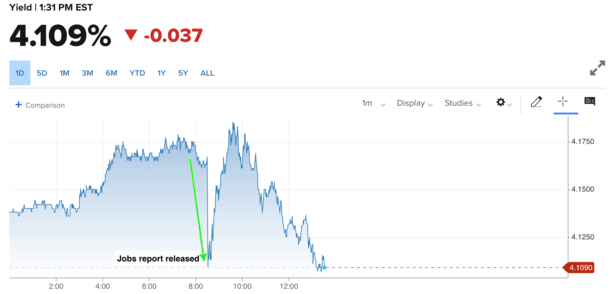
Thanks to another super weak jobs report, mortgage rates avoided a move even higher.
As we can see from the 10-year bond yield chart above, they were making their way toward 4.20% before the report was released.
Had it exceeded expectations, there was a very good chance we’d have a 10-year yield back around 4.20% if not even higher.
Combined with the current spread of roughly 200 basis points (bps), you’d be looking at a 30-year fixed mortgage rate around 6.25%.
Instead, mortgage rates are holding the line today and will likely be unchanged with most banks and lenders.
Essentially, we avoided another big disaster for rates, which have been under immense pressure all week thanks to Iran, surging oil prices, and the Strait of Hormuz.
Speaking of oil prices, they topped $90 today as the conflict appears to be intensifying, with new strikes carried out and a statement from Trump early this morning saying, “There will be no deal with Iran except UNCONDITIONAL SURRENDER!”
Simply put, this conflict doesn’t appear to be going away anytime soon.
That means gas prices will likely stay elevated for the foreseeable future, adding to inflation concerns at a time when the Fed is expected to keep cutting rates.
As such, mortgage rates may have a tough time moving much lower until this issue is resolved.
But We Could’ve Had a ~5.75% 30-Year Fixed by Now
I was thinking had this whole thing not taken place, chances are mortgage rates would be deep into the 5s by now.
As noted, the 10-year bond yield was already sub-4%, and had it remained mostly flat sans the conflict, it’d likely be even deeper into the 3s today.
The 30-year fixed, which was around 5.99% prior to this week may have been making its way toward 5.875% and then 5.75%.
And at a critical time for the housing market, given it’s the hottest time of the year for home buying.
Instead, we’re facing a ton of uncertainty, something I spoke about recently.
Sure, mortgage rates are only .125% to .25% higher than they were a week ago, which translates to a nominal increase in housing payment.
But now we’ve got a world full of doubt, something that might give a prospective home buyer pause given affordability is already unfavorable.
The best-case scenario is this conflict gets resolved sooner rather than later, both for all parties involved, the economy, and mortgage rates.
(photo: Paula Rey)

- Jobs Report Miss Keeps Mortgage Rates From Getting Even Worse - March 6, 2026
- Mortgage Rates Back to Recent Highs on War Uncertainties - March 5, 2026
- Mortgage Rates Ease Back Toward 6% Thanks to Oil Assurances From Trump - March 4, 2026