
Mortgage rates feel pretty hopeless right now.
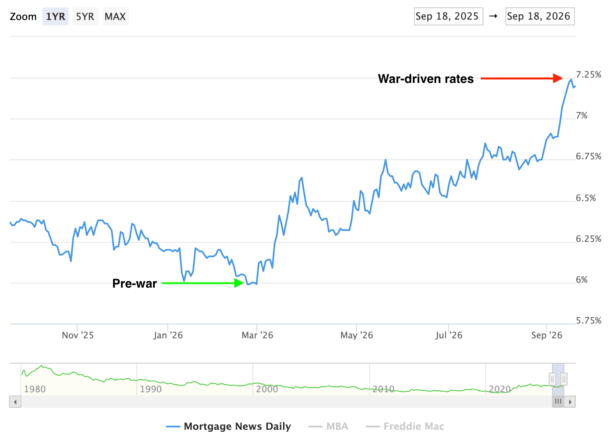
They’ve risen from sub-6% to the mid-7s in just the past six months.
With a meteoric rise over the past month, climbing nearly a full percentage point.
At this time last month, the 30-year fixed was around 6.75% and today it’s closer to 7.5%.
So what can save mortgage rates, if anything at all?
End the War, Bring Down Mortgage Rates
One of the biggest factors right now when it comes to mortgage rate movement is the conflict with Iran.
It has led to much higher energy prices, which translates to higher inflation.
That has forced the Fed to begin hiking again, with one hike already in the books and several more hikes potentially coming.
Prior to the conflict, the 30-year fixed was sub-6%, its best level since the summer of 2022.
As a quick reminder, mortgage rates were still in the low 3s in early 2022.
So the fact we were talking about the year 2022 was a huge victory for prospective home buyers and those looking to refinance.
But that all changed in a heartbeat when the war broke out, sending bond yields surging.
There was hope of a speedy resolution, but that has dimmed tremendously with the impasse in the Middle East now approaching month eight.
Long story short here, end the war and mortgage rates would benefit a ton. They likely wouldn’t come back down to sub-6% levels right away, but you could get them back into the 6s.
[Compare different mortgage rates side by side with my mortgage rate calculator.]
Weak Jobs Data Could Help Too
The next biggest driver is labor. Since the war is an inflation story, the other big piece is labor.
The Fed concerns itself with both, as does the bond market.
Lately, jobs data has been a little more positive than expected, which puts additional pressure on mortgage rates.
If we get a weaker-than-expected jobs report that points to economic cooling, you can get lower mortgage rates that way too.
It’s not the best path because you don’t want people losing their jobs (it’s counterintuitive).
But it is the other way the economy shows sign of slowing, which could give the Fed pause concerning additional rate hikes.
The Fed doesn’t set mortgage rates, but the bond market takes cues from Fed rate expectations.
And if they’re expected to keep hiking, the pressure builds on 30-year fixed mortgage rates too.
Granted a lot of that pressure already seems to be priced in, with rates up 75 basis points over the past month.
Taken together with the war-driven increase, we’re looking at rates about 150 bps higher than they were at the beginning of March.
Back then we had a 6% 30-year fixed (perhaps even 5.875%), and today homeowners are facing a 7.5% rate instead.
That’s pretty painful, especially since housing affordability was already out of reach for many even when rates were lower.
Midterm Magic for Mortgage Rates?
Perhaps President Trump and his pals will come up with some midterm magic to get mortgage rates down, knowing housing is always a hot button issue.
Trump campaigned on bringing back the low mortgage rates, but so far it hasn’t gone according to plan.
Not even close.
He’s aware of this and likely wants to fix it. Same with Treasury Secretary Scott Bessent.
But they’ve struggled to make any headway there. Knowing the midterms are right around the corner, they might be even more inclined to find a solution to the high-rate problem.
That could be more motivation to make a deal with Iran, which again is the main driver of mortgage rates lately.
So even if the President and company want lower rates, it’s ultimately the same solution to get them lower. End the war.
That eases pressure on inflation, which is arguably what caused mortgage rates to surge higher again this year.

- What Can Save Mortgage Rates? - September 28, 2026
- What’s Next for Mortgage Rates?7.50%? 8%? - September 24, 2026
- Mortgage Rates Now Highest Since Trump Took Office - September 23, 2026