
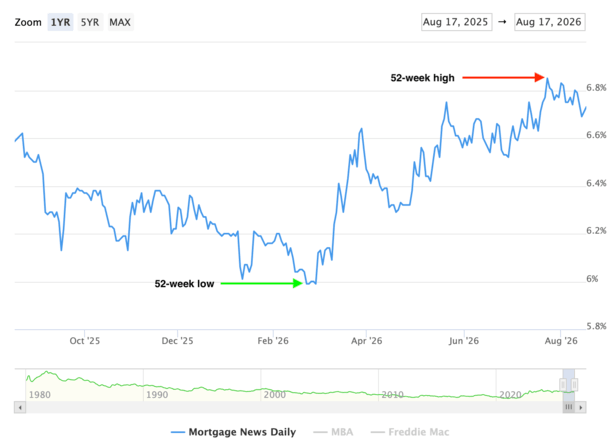
While they aren’t at their absolute worst, mortgage rates remain very close to their one-year high.
They’re about .125% below their 52-week highs, which were seen in late July before we got some favorable economic data.
However, they remain stubbornly high with no real relief in sight.
Let’s break down how they got here and why they remain sticky at these levels.
And how they could finally break this unfriendly trend and move lower again.
1. Iran War and Elevated Oil Prices
Without a doubt, the biggest driver has been the Iranian conflict and the higher oil prices that came with it.
Why? Because before that took place at the end of February, mortgage rates were below 6% for the first time since late 2022.
They were enjoying their best levels in three and a half years!
Then seemingly overnight (but in reality over the course of just one month), they increased to about 6.625%.
That’s a nasty move higher and could only be explained by the geopolitics that nobody saw coming at the time.
I think if you remove that conflict from the equation, mortgage rates would likely be in the low 6s today (or even lower).
They probably wouldn’t be markedly lower than those late February/early March levels, but they certainly wouldn’t be at or near one-year highs.
So if you want major relief, you end that war and hope oil prices come back down.
There was some positive movement this week after the U.S. signaled a move away from actual warfare and into economic sanctions instead.
We’ll see how that goes, as everyday it seems the script changes.
2. High Government Debt and Bond Issuance
Another big issue at the moment is the amount of government debt, which just recently officially passed the $40 trillion mark for the first time in history.
That means there’s a lot of bonds out there, and with increased supply comes the need for higher yields to attract investors.
This is one reason why we’ve seen yields on government bonds like the 10-year (which acts as a bellwether for 30-year fixed mortgage) hit 52-week highs recently.
They’ve since eased a bit but aren’t far from the high seen in late 2023 (around 5%) when the 30-year fixed climbed to 8%.
Simply put, we need to get our spending under control, balance the budget, and make our debt attractive again to the rest of the world.
If we don’t, it increases the cost of lending for everyone, including those seeking a student loan or a mortgage.
3. AI Investment Flooding the Bond Market
Along those same lines, we’ve got a massive AI buildout that requires a ton of capital.
Instead of paying cash, these tech companies are issuing bonds so they can raise funds and pay for all their expensive datacenters.
Those bonds compete for the same investors that buy things like Treasuries or mortgage-backed securities (MBS).
Again, to attract investors, they need to offer higher yields (interest rates) to lure in the buyers.
This puts additional upward pressure on mortgage rates as increased supply leads to higher yields on all fixed-income securities.
As we all know from economics, it’s simple supply and demand. You have too much of something, the price goes down.
To offset the drop in price, the yield goes up and it needs to move ever higher to become attractive.
Limit the supply and the price can go up, and the yield can drop too.
4. Sticky Inflation
There’s also the matter of inflation, which has proven to be sticky and above the Fed’s long-term target of 2%.
At last glance, it remains above 3%, whether you rely on CPI or the Fed’s preferred PCE index.
Speaking of PCE, it’s due out Wednesday and the consensus is prices up 3.6% from a year ago (+3.3% for core).
While oil has been the scapegoat of late, we’ve yet to really shake the price increases in other categories whether it’s software, tech components, transport, or even housing services inflation.
We got hot inflation reports for April and May, which also coincided with a hot jobs report, which led to the highest mortgage rates in about a year.
Fortunately we’ve had some cooler reports lately that took some of the pressure off, but we’re not out of the woods yet.
Especially with President Trump announcing fresh tariffs on Canada.
5. Fed Rate Expectations
I’ll keep it short and sweet and end this with Fed rate expectations, which are hikes or cuts (or doing nothing).
They are driven by the aforementioned reports, whether it’s CPI, PCE, or the monthly jobs report.
While the federal funds rate is an overnight rate (very short duration) and the 30-year fixed mortgage is well, a 30-year loan, there is some influence from the Fed.
The Fed doesn’t set consumer mortgage rates but it does have some say.
If investors expect the Fed to hike, bond yields tend to rise and mortgage rates move higher as well.
If they expect a cut, the opposite happens and mortgage rates tend to come down.
However, this happens before the Fed actually announces its policy decision, and is largely baked in by the time of the FOMC announcement.
There was a while where it appeared the Fed would hike thanks to that hot economic data and the Iran war.
But recent, cooler reports might allow the Fed to avoid another hike, especially if new Fed chair Kevin Warsh can convince the others it’s the right move.
That line of thinking has allowed mortgage rates to step back from their one-year highs, but only marginally.
Until we solve Iran and the inflation comes with it, mortgage rates will have a tough time moving much lower.
The good news is they might be near their top and not necessarily at risk of moving much higher either.

- Have Mortgage Rates Finally Hit a Wall? - October 9, 2026
- Mortgage Rates Stuck Near Recent Highs Despite a Strong Bond Auction - October 8, 2026
- UWM Removes Minimum Credit Scores on Most Mortgages - October 7, 2026