
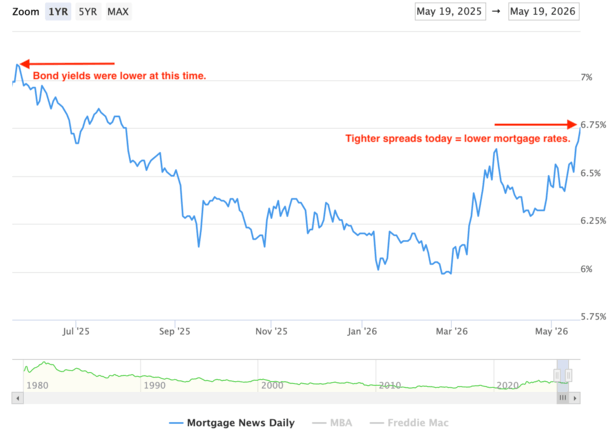
It’s been a very bad month for mortgage rates, yet they remain below year-ago levels.
And by some margin too. Had this been last year, we’d be staring at a 7-handle 30-year fixed.
Instead, the 30-year fixed is hovering around 6.75%.
Sure, it’s still not great news, but it tells you that conditions are a lot better than they were in 2025.
The reason: mortgage spreads are no longer blown out like they were back then.
Tighter Spreads Keeping Mortgage Rates Below 7%…For Now
The 10-year bond yield ticked even higher today on continued fears of inflation tied to the Middle East conflict.
At last glance, it was up another four basis points to around 4.66%, the highest since last January.
Despite that, the 30-year fixed isn’t even close to its 52-week high.
That high, according to Mortgage News Daily, was 7.08% almost exactly a year ago to the day.
So we’re roughly 0.375% lower now versus back then, despite bond yields being higher.
The 10-year bond yield is a bellwether for 30-year fixed mortgage rates and the pair move in relative lockstep.
This means they always tend to move in the same direction. However, there is a spread between the two to compensate mortgage-backed securities (MBS) investors for the added risk.
That risk is mainly prepayment risk because most mortgages have either an explicit or implicit guarantee in the event of default.
The spread varies, but historically has been around 170 basis points higher for the 30-year fixed.
In other words, during normal times, a 4% 10-year bond yield would result in a 30-year fixed around 5.70%.
Today, the spread is pretty close to normal, around 210 basis points.
While that sounds high, consider the fact that it was about 250 bps a year ago. That’s why the 30-year fixed was averaging 7.10% with even lower bond yields.
If we had totally normal spreads right now, we’d be looking at a 30-year fixed around 6.375%.
So yes, it could be even better, but it could be worse. And this phenomenon is keeping us below 7%, for now at least.
Why Are Spreads So Much Better Now?
Mostly because prepayment risk has subsided. Ultimately, mortgage rates have kind of settled in at current levels between 6% and 7%.
They’ve been here for a while now and don’t appear to be going anyplace else, anytime soon.
As such, there’s more certainty for MBS investors looking for a certain yield on their investment.
They don’t have to worry as much about these mortgages getting paid off immediately thanks to some refinance boom driven by markedly lower mortgage rates.
From 2023 to 2025, there was a lot of disruption and uncertainty in the secondary market as QE ended, QT began, and mortgage rates nearly tripled.
That meant pricing had to be more defensive than it typically would be, hence the blown-out spreads.
At one point, these were as wide as 325 bps, which explains how we got an 8% 30-year fixed late in 2023.
That’s no longer the case and perhaps a lot of investors are looking at a premium of 200 bps as pretty solid for a home loan with an implied or explicit guarantee to be repaid.

- No Relief for Mortgage Rates as August Jobs Report Comes in Hot - September 4, 2026
- Mortgage Rates Are at New 2026 Highs, But There’s a But - September 2, 2026
- Mortgage Rates Higher Thanks to First Military Strikes in a Month - August 31, 2026