
You’ve probably heard that mortgage rates hit a new 2026 high.
That’s true. The 30-year fixed climbed to 6.89%, per the latest daily rate update from Mortgage News Daily.
It is indeed the highest point of 2026, and the highest point in over 52 weeks as well.
The last time the 30-year fixed was this high was all the way back in June of 2025.
But it’s not really as bad as it seems because the recent increases have been super incremental.
New 2026 High for the 30-Year Fixed
Allow me to find a silver lining while everyone else is panicking that mortgage rates are at 2026 highs.
I get it. They’re “high” right now. The highest they’ve been in over a year in fact.
The 30-year fixed is pushing toward 7% again, something it hasn’t done since last May.
That’s clearly not great news, and it means another year will go by with home sales crawling around 30-year lows.
It means mortgage refinance business continues to be abysmal, and it means banks and mortgage lenders are struggling mightily.
Definitely not a lot to cheer about right now.
Housing affordability was already bad when rates were closer to 6%, and now it’s even worse.
But before we get in a tizzy, let’s zoom out and look at this all in context.
The 30-year fixed did hit a new high, but just barely. We’re talking a few basis points here and there.
The new high achieved yesterday was literally two basis points higher than the prior high.
So MND said the daily average was 6.89%, up from 6.87%. That wouldn’t even register for most mortgage lenders.
Their rate sheet wouldn’t even change. The pricing you saw yesterday would likely be the same today.
Before this latest run up, the 30-year fixed hit a 2026 high of 6.85% back in late July.
So our new highs have moved up a whopping four basis points. From 6.85% to 6.89% over the span of a month.
Are Mortgage Rates Near a Ceiling?
Now my silver lining might not mean a whole lot if mortgage rates keep ascending.
But they don’t appear to be on track to do that. If you look at the new highs, as noted, they’re a few bps higher.
This isn’t 2022-2023, when the 30-year fixed climbed from 3% to 8% in the span of less than 12 months.
This is mortgage rates moving from the low 6s to the high 6s (after being in the 7s).
For perspective, that’s a percentage increase of roughly 15% versus the 167% increase from 3% to 8%.
This is one of the “benefits” of a higher starting point for mortgage rates.
If we’re already at 6%, going to 7% isn’t so bad.
When we were at 3%, going to even 4% or 5% was bad enough. It was a huge jump.
Now it’s just an incremental rise.
Mortgage Rates Stuck in a Range
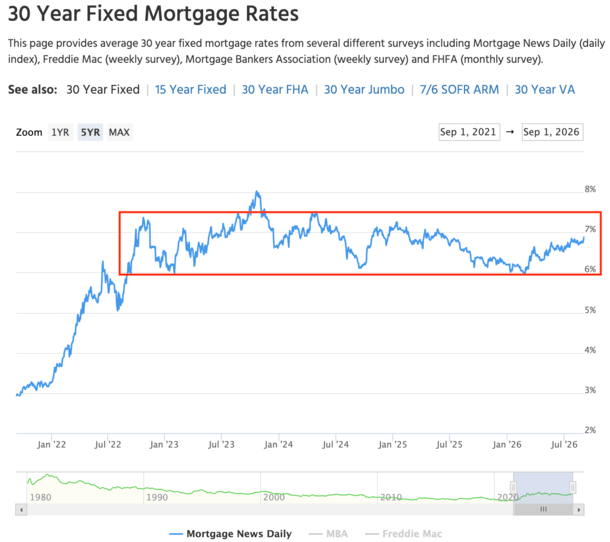
It’s also worth noting that we’ve been in this range for years now. The 30-year fixed has bounced around these levels for literally four years.
This isn’t an acute moment. It’s the latest move higher for rates as they continue to ebb and flow within this range.
Sometimes they’re in the 7s, sometimes they dip toward the low 6s. Right now they’re pushing up again, but might not even hit a 7-handle again.
Sure, the trend isn’t our friend right now. It’s been rough since the war got going in early March.
But if we zoom out, mortgage rates aren’t surging out of control. They’re just back toward the top of their recent range.
Importantly, that means they could also be close to topping out again and due for some much-needed relief.
Read on: Use my mortgage rate calculator to compare rates that are an eighth apart.

- Mortgage Rates Keep Falling on AI Rout, But Will It Last? - October 16, 2026
- Mortgage Rates Plummet Despite Hot Wholesale Inflation Report - October 15, 2026
- Mortgage Rate Winning Streak Comes to an End - October 14, 2026