
Mortgage rates got a little boost today thanks to an apparent peace deal between the U.S. and Iran.
However, the 30-year fixed remains well above the average seen before the war began a few months ago.
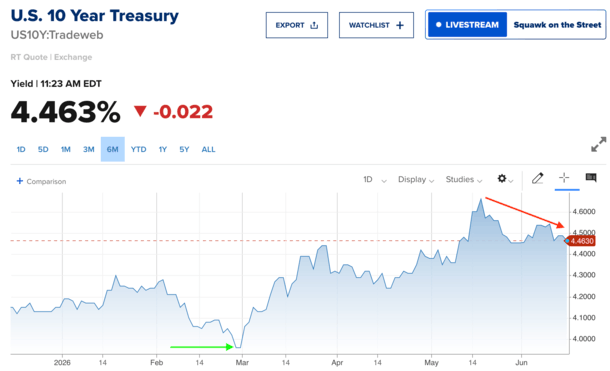
At last glance, it was still priced about 5/8 higher than where it stood at the very end of February.
This tells me investors are cautious about a possible accord.
And that peace deal or no peace deal, it will take time for mortgage rates to sink back to those lows.
If You’re Waiting for Lower Mortgage Rates You Need to Be Patient
Those hoping for an immediate return to sub-6% mortgage rates might need to be patient.
While it’s certainly encouraging to hear that a peace deal is in the works, there are still a lot of question marks.
And there’s always the possibility that something erupts that puts it all into question again.
As such, bond traders and investors of mortgage-backed securities (MBS) seem to be overly cautious.
It might explain why the 10-year bond yield remains closer to 4.50% instead of sub-4% as it was back in February.
What that means for home buyers and homeowners looking to refinance is that mortgage rates will stay elevated all else equal.
We had a 30-year fixed mortgage rate below 6% prior to the war. But now we’re facing rates above 6.5% for the most part.
You can call it the war premium, or perhaps tie it to higher inflation concerns related to the spike in oil prices.
Whatever the case, it’s going to take time for mortgage rates to get back to those low levels.
Even if the oil starts flowing again and the ships start moving, the damage is already done.
There’s also the thought that a premium will remain in place regardless on concerns that things could unravel or ratchet up again.
In other words, mortgage rates might just remain an eighth to a quarter higher on these risks that we didn’t have a few months ago.
So if the peace deal is for real and it holds, we might get mortgage rates back to the low-6s, but not quite where they were before this whole thing got going.
Are Mortgage Rates Higher for Other Reasons Too?
There’s also the thought that interest rates aren’t just higher because of the war with Iran.
We’ve had a really strong stock market rally driven by a frenzy in tech stocks this year.
Namely, semiconductors and anything to do with artificial intelligence (AI).
The sky-high valuations might be adding to fears of a bubble and the need for rate hikes instead of cuts to cool things down.
If that’s the case, Fed rate expectations can certainly put upward pressure on mortgage rates as well.
So even if the war piece is figured out, we could still have issues that keep mortgage rates elevated for the remainder of the year.
Long story short, it might mean that a sub-6% 30-year fixed continues to be elusive.
And possibly something we won’t see in 2026.
In fact, the only way we might see it is if there’s an economic downturn such as a recession, which clearly nobody wants to save a few bucks on their mortgage.
Read on: Try out my new mortgage rate calculator to quickly compare monthly payments.

- Maybe Mortgage Rates Did Like the Fed Rate Hike After All - September 17, 2026
- What Will Today’s Fed Rate Hike Mean for Mortgage Rates? - September 16, 2026
- Is Chase’s Mortgage Rate Sale a Good Bet on Lower Interest Rates in the Near Future? - September 15, 2026