As expected, the Fed left rates unchanged this week, though there was an outside chance they were going to raise 25 basis points.
It turned out to be a holding steady situation as most envisioned, though three board members did dissent.
That included Dallas Fed President Lorie Logan, Cleveland Fed President Beth Hammack, and Minneapolis Fed President Neel Kashkari.
They all wanted a 25-bp hike, with Logan saying she thought rates should be “modestly higher.”
However, President Trump said new Fed chair Kevin Warsh wants lower rates and is essentially hamstrung by a “political board.”
Does Kevin Warsh Want Lower Mortgage Rates?
As always, I need to point out that the Fed doesn’t set mortgage rates, though monetary policy does play a role.
And the reason we had record low mortgage rates for much of the past decade was because of the Fed’s Quantitative Easing (QE) program.
While that’s likely not coming back anytime soon, the Fed is at a crossroads with inflation rising again and the economy under threat from increased layoffs, AI, and a protracted war in the Middle East.
For now, it appears they can see through the rise in oil prices, which have driven inflation higher.
That means they can keep rates as they are, with neither a hike necessary nor a cut justified.
It’s pretty much no different than when Jerome Powell was the chair, except now we have the unknowns of a serious war to consider.
If you recall, Trump chose new chair Kevin Warsh because he was fed up (no pun intended) with Powell for not cutting rates fast enough.
But now Warsh is in the same boat as Powell, though Trump pointed out that it’s not his fault (unlike Powell).
After the Fed announced that it had held steady, Trump told the press that “Kevin’s fantastic, but he’s got a board.”
Adding that “I know he’d love to see lower interest rates, but he’s got a board, and it’s a political board, and they want to keep rates up.”
Trump Has the Power to Get Mortgage Rates Lower!
Now the ironic part. While Trump is quasi-complaining again that the Fed isn’t doing what he wants, he in fact might have more power than them.
Ultimately, the Fed is simply following the economic data, which is driven to some degree by government policy.
Remember Trump’s tariffs? And his new ones. Those are said to increase inflation, which would require either a rate hike or at minimum no rate cuts.
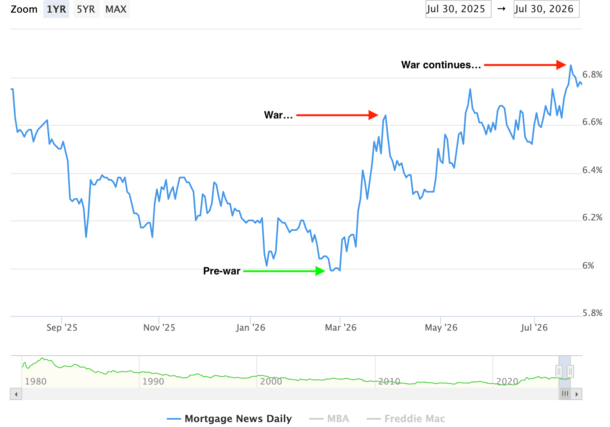
What about the war with Iran? Again, that has led to the closure of the Strait of Hormuz, a key channel for energy transport.
As a result, the price of oil has skyrocketed, leading to another unwanted bout of inflation.
Simply put, mortgage rates don’t like inflation because it erodes the value of the underlying bonds.
That means mortgage-backed securities (MBS) investors require a higher yield (interest rate) in order to buy them. So mortgage rates go up.
Perhaps if Trump didn’t keep threatening tariffs, and didn’t get us into another war, mortgage rates would be doing what he wanted.
And the Fed could also keep cutting, making government debt cheaper to repay at the same time.
Instead, policies that drive up interest rates continue to get unleashed, making it impossible for Trump to reach his goal of bringing back those 3% mortgage rates he promised us.
A 25-bp rate hike or cut wouldn’t move 30-year fixed mortgage rates much.
But ending the war, or tariffs, or avoiding other policies that drive up government spending and inflation could be a huge tailwind for mortgage rates.
That would also allow Warsh (and the rest of the Fed board) to play ball accordingly.
- Maybe Mortgage Rates Did Like the Fed Rate Hike After All - September 17, 2026
- What Will Today’s Fed Rate Hike Mean for Mortgage Rates? - September 16, 2026
- Is Chase’s Mortgage Rate Sale a Good Bet on Lower Interest Rates in the Near Future? - September 15, 2026