In somewhat astonishing fashion, at least to me, mortgage rates have been falling all month. And by a fair amount.
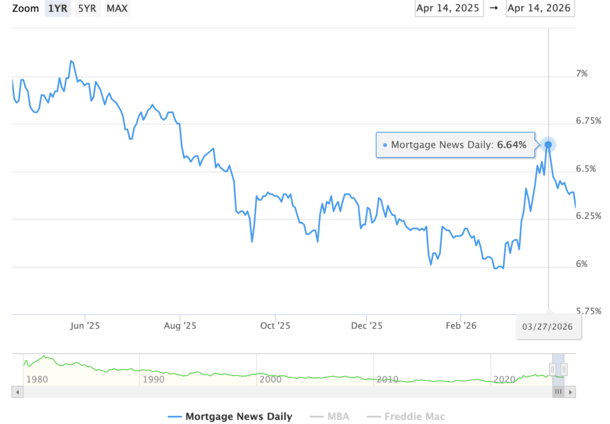
After a really ugly March, in which rates surged from sub-6% levels to around 6.625%, they’ve since come down quite a bit.
At last glance, the 30-year fixed was back around 6.30%, which by all accounts is a very good average.
After all, the sub-6% rates were the lowest in 3.5 years, so being just 30 basis points above those levels ain’t so bad.
But how is it even possible given the ongoing geopolitics, which have caused energy prices to soar globally?
Hope for a Resolution in Middle East Pushes Mortgage Rates Back Down
In a nutshell, mortgage rates are lower because there’s hope of some sort of resolution in the Middle East.
We already saw talks in Pakistan last weekend, albeit talks that didn’t seem to end with anything positive.
There’s also a ceasefire in effect, which seems to be holding up okay for now.
And now word that additional talks are going to take place in Islamabad, with Trump telling Maria Bartiromo that, “I view it as very close to being over.”
Meanwhile, the U.S. has initiated their own blockade of the Strait to exert further pressure on Iran to open the Strait.
With Trump saying on his Truth Social platform that “China is very happy that I am permanently opening the Strait of Hormuz. I am doing it for them, also – And the World. This situation will never happen again.”
This all somehow points to an end to the conflict (color me skeptical), which would ostensibly result in lower oil prices and reduced inflationary concerns.
As such, 10-year bond yields have fallen, and 30-year fixed mortgage rates have dropped about 33 basis points (0.33%) this month, per MND.
We aren’t back to normal just yet, but rates are a lot lower than they were in March, which should spell some relief for prospective home buyers.
I don’t know if it’ll entice existing homeowners to apply for a mortgage refinance just yet, but we’re at least moving in the right direction.
Labor Over Inflation Again If This Proves to Be Short-lived
I was discussing this very topic over on LinkedIn with Kevin Peranio, the chief lending offer at PRMG.
I expressed a little bit of disbelief regarding the recent fall in mortgage rates and he aptly pointed out that “geopolitical events are always seen as a short-term issue going back to WWII.”
He added that despite the inflation spike related to energy, everything else was tame and on track, as it had been before this unexpected event (that’s why rates were at 3.5-year lows!).
And he added that, “Labor is long term trending weaker and is a major macro factor. One can argue labor over inflation is still the major macro force.”
Taken together, it’s a good point and a good reminder that when we zoom out, the same main forces remain in play.
There are lot of concerns about the job market, which translates to lower mortgage rates all else equal. And labor still supersedes inflation for the Fed.
While the Fed doesn’t set consumer mortgage rates, Fed rate expectations play a role in bond prices and their direction.
So if they’re most concerned with labor, so are bond traders, and so are mortgage-backed securities (MBS) investors, and finally so too are mortgage lenders!
And that’s how you get lower mortgage rates, despite all that’s going on.
To cap it all off, mortgage rates are lower, but still above recent levels, so they remain inflated because of current events.
It just appears they don’t need to be as inflated as they were in March on expectations things will get better, and this too shall pass. As these things always seem to.
Final caveat; Mortgage rates could still turn higher depending on what transpires in the coming weeks and months, so don’t get too comfortable here nor look a gift horse in the mouth!
Read on: Should I lock or float my mortgage rate?

- Opendoor Wants to Sell You a Home With 2% Down and No Mortgage. What’s the Catch? - October 26, 2026
- Mortgage Rates Holding Onto Recent Improvement Heading Into Fed Week - October 26, 2026
- Mortgage Rates Back on the Rise After Biggest Bond Rally Since 2023 - October 23, 2026