
There are several ways to get lower mortgage rates.
You can get inflation down, which is a positive for bonds and thus mortgage-backed securities.
Or you can get a slowing in the economy, driven by fewer job opening, higher unemployment, etc.
Sadly, that latter path seems to be the one that’s “working” at the moment, not the former.
After all, lower mortgage rates don’t do much good if fewer people have jobs.
Weak Jobs Report Provides Some Relief for Mortgage Rates
The monthly jobs report came out this morning and it was a lot weaker than expected.
Only 29,000 jobs were created in the month of September, well below the 84,000 forecast.
And the unemployment rate climbed to 4.2%, up from 4.1% a month earlier, also above consensus.
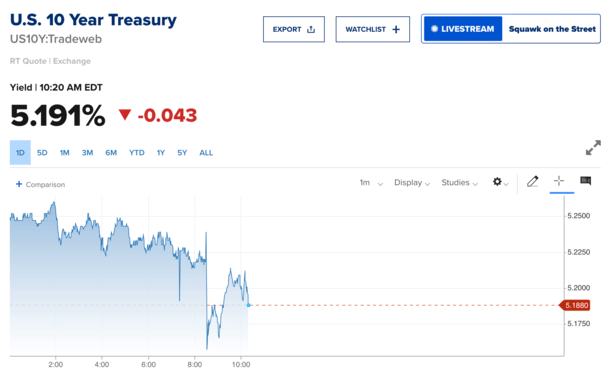
That initially led to a little drop in bond yields, which have been on a tear higher for the past month.
But it was short-lived, eventually turning the other way despite the poor numbers.
Still, mortgage rates might print flat to slightly lower today because of it.
Bond yields (and mortgage rates) had a good day yesterday, perhaps front running the jobs report.
There was a mystery drop in bond yields Thursday around 1pm EST after the bellwether 10-year yield crested at 5.34%.
So maybe just maybe the weak jobs report today didn’t have as much gusto as it otherwise would have.
As it stands now, we’re still nearly 10 bps lower than those high levels yesterday, and 30-year fixed mortgage rates are also off their recent highs.
Pressure on Mortgage Rates Is Coming From All Other Angles
Even if the labor data continues to come in weak (this report is but one report), there is upward pressure just about everywhere else you look.
We’ve got out of control government spending, we’ve got lots of bond issuance to fund the war in the Middle East.
We have a second wave of inflation, driven by higher energy prices, diesel shortages, etc.
There’s also the massive AI build out taking place, which creates more bonds that crowds out investors who might otherwise buy Treasuries or MBS.
So even if we get cooler-than-expected jobs numbers, they might not help mortgage rates all that much.
Labor was the focus earlier this year when it seemed like inflation was old news.
But then the war broke out with Iran and inflation once again became the more important issue.
This means not only is the jobs report a bad way to accomplish the goal of lower mortgage rates (since it’s otherwise bad for the housing market).
It’s also just not that effective at the moment. It’s no longer the chief concern for the Fed or the bond market.
[Compare mortgage rates and monthly payments side by side with my mortgage rate calculator.]
Labor Is No Longer the Top Driver of Mortgage Rates (It’s Inflation Again!)
If things got really ugly again on the jobs front, sure, it could take center stage again.
But the limited downside movement after such a poor jobs report tells you it’s all the other things mentioned that matter.
In other words, if you want mortgage rates to go down, you want to root for an end to the war, which would lead to less government spending, lower deficits, and falling energy prices.
Those are all positive things that could bring mortgage rates down without hurting the housing market at the same time.
It’d also be a sustainable path for the housing market, where employment remains healthy but interest rates are no longer cost-prohibitive.
Read on: How are mortgage rates determined?

- Least Desirable Path to Lower Mortgage Rates the Only One Working Right Now - October 2, 2026
- Are 8% Mortgage Rates a Foregone Conclusion? - October 1, 2026
- Mortgage Rates Waiting on the Jobs Report for Their Next Move - September 30, 2026