
Well, we got a tame PCE report this morning, which would normally be good news for mortgage rates.
But instead of seeing bond yields drop and relief come, rates are under pressure once again.
Part of the reason might be that GDP (and consumer spending) also came in stronger-than-expected today.
The other might be that bond traders are awaiting another key jobs report due out Friday.
There’s also the simplest explanation: that the trend is just not our friend right now.
PCE Inflation Report Comes In Cooler Than Expected
First things first. The Fed’s preferred inflation gauge, the PCE report, came in cooler-than-expected today.
That should be good news for mortgage rates. Any inflation reading that is below forecast should in theory mean less pressure on bond yields (interest rates).
In normal times, it might lead to lower bond yields on the day, which would translate to lower 30-year fixed mortgage rates as well.
Not the case today, perhaps because we also got stronger-than-expected GDP, driven by robust consumer spending.
There’s also the massive AI build-out taking place, which is also driving GDP higher.
But when you ignore AI infrastructure and consider that household budgets are beginning to crack due to higher prices, including gas prices, you start to wonder.
After all, consumer confidence just hit its lowest point since 2014. So just how strong is the economy today?
As a rule of thumb, a weaker economy leads to lower mortgage rates and vice versa.
So if and when this presents itself, mortgage rates might finally see some relief.
Is It Labor Over Inflation Again?
The story lately has been all about inflation, driven mostly by the war with Iran, which has led to surging energy prices.
Aside from having to pay more at the pump, diesel prices will make their way into everything else we buy (or need transported).
That puts additional pressure on rising prices and makes the Fed more likely to hike.
However, rate hike expectations plummeted yesterday after New York Fed President John Williams said there was “no urgency” for more hikes.
The sure-thing October hike that had odds of 70% on CME a week ago is now down to 39%. Yes, it can change again, but it’s a lot less likely at the moment.
At the same time, the JOLTs report revealed fewer job openings, meaning employers aren’t looking to hire as many people.
This can relieve upward pressure on wages and ease inflation, despite that uptick in consumer spending.
On Friday, we’ll get the monthly jobs report from the BLS, which could further strengthen the argument that labor isn’t so robust these days.
That would be the other way to see bond yields ease and mortgage rates drop.
It’s not the preferred path since it’s not good for the economy or individual workers, but it’s the other way to get lower mortgage rates if inflation isn’t cooperating.
So that’s the report you want to keep an eye on if you’re tracking mortgage rates this week.
The Economic Data Has to Keep Coming in Favorably to Avoid 8% Mortgage Rates
The comments from Williams helped somewhat, as did the cooler-than-expected PCE and JOLTS report.
But without an equally cool jobs report on Friday, we might see mortgage rates continue to tick higher and higher.
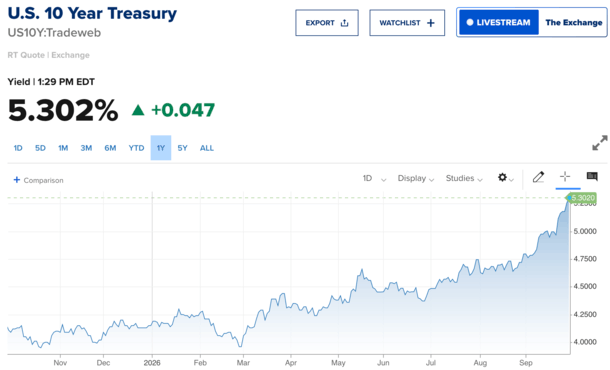
At last glance, the 10-year bond yield was at a new 52-week high of 5.30% today, which implies a 30-year fixed around 7.625% or higher.
If the economic reports don’t go our way, 8% mortgage rates aren’t out of the question soon.
Of course, there’s still the other long shot path, getting some sort of good news on the Middle East conflict.
That could really help mortgage rates too.
Read on: Check out my mortgage rate calculator to compare different mortgage rates side by side.

- Mortgage Rates Waiting on the Jobs Report for Their Next Move - September 30, 2026
- Mortgage Rates Could Top Out at 8.88% If History Repeats - September 29, 2026
- Rocket Mortgage Making the Switch From FICO to VantageScore - September 28, 2026