
Just days after the big Jackson Hole Fed event, mortgage rates are under pressure for other reasons.
The reason? The ongoing conflict in the Middle East, which had been quiet for about a month until last night.
The U.S. and Iran reportedly exchanged missiles for the first time since late July, sending oil prices, bond yields, and mortgage rates higher.
It’s also a departure from the economic punishment angle the United States had unveiled in recent days to avoid ongoing fighting.
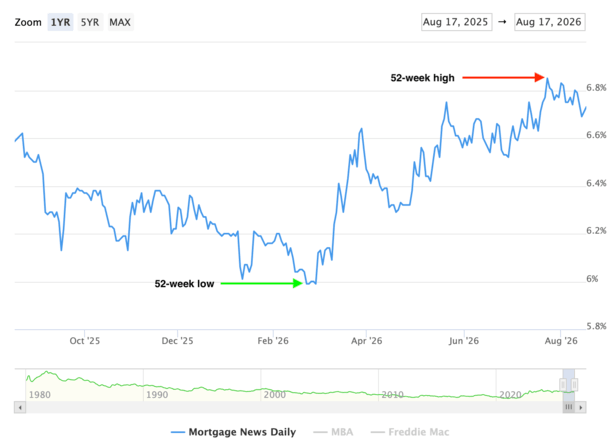
And if it ratchets up again, mortgage rates could hit fresh 52-week highs.
Mortgage Rates Continue to Move Most with Iran/Oil
It seems pretty clear now that the biggest mover for mortgage rates lately is the war with Iran.
Anytime things deteriorate there, bond yields and mortgage rates turn higher.
And if we zoom out, they’re nearly one full percentage point higher compared to late February, before the conflict began.
It seems they can’t catch a break, with some sort of skirmish (or worse) always materializing after a few days of relative calm.
With the war now about six months in, folks are starting to wonder how long this might persist, along with the larger consequences.
The biggie is the price of oil, which shot up after the conflict first got underway. Prices have remained elevated since.
While prices are off the highs seen in the direct aftermath of the first strikes in late winter, they are well above the pre-war levels with no real relief in sight.
That puts pressure on just about every area of the economy, as energy flows into everything whether it’s the production itself or eventual transit of a given product or service.
The end result in higher inflation, which has been the thorn in mortgage rates’ side for years now.
Persistent inflation may also force the Fed to hike its own federal funds rate again, though new Fed chair Kevin Warsh has been cagey about that since taking over.
Could Mortgage Rates Reach New 2026 Highs?
The other day, I laid out the reasons why mortgage rates are near their 2026 highs.
As is obvious, Iran is one of the biggest factors. But there’s also AI buildout and high government debt/spending.
So even if all is quiet on the war front, mortgage rates could remain elevated for the foreseeable future.
However, they could get WORSE if the situation in the Middle East deteriorates as well.
And given mortgage rates are already very close to their 52-week highs, it wouldn’t take much to hit new highs.
The monthly jobs report this Friday could further exacerbate things if it comes in hot, or settle things down if it comes in cooler-than-expected.
Mortgage Rates Have Done Well to Avoid a Return to 7%
So far, mortgage rates have done a good job avoiding a return to 7%.
While they’re only an eighth or a quarter-percent below those levels, there’s a psychological hit if they get back above 7%.
The monthly payment between 6.75% and 7% isn’t massive (check with my mortgage rate calculator), but it’d be enough to hurt home buyer sentiment.
And push home sales even lower than they already are, which are currently hovering around 30-year lows to begin with.
Not to mention the lack of mortgage refinance business, which has already tanked and could spell trouble for the many mortgage lenders out there treading water.
Long story short, a lot is at stake with mortgage rates on the cusp on 7%.
If they can remain at current levels, that might be considered a win for now, even if they remain markedly higher than the sub-6% rates seen as recently as early March.
Update: The 30-year fixed just hit a fresh 52-week high of 6.87% per Mortgage News Daily.

- Stuck Mortgage Rates Starting to Hurt the Real Estate Industry - October 21, 2026
- Mortgage Rates Move Lower Thanks to Record Low Pending Home Sales - October 20, 2026
- Fannie Mae Ups 2027 Mortgage Rate Forecast to 7.5% - October 19, 2026