
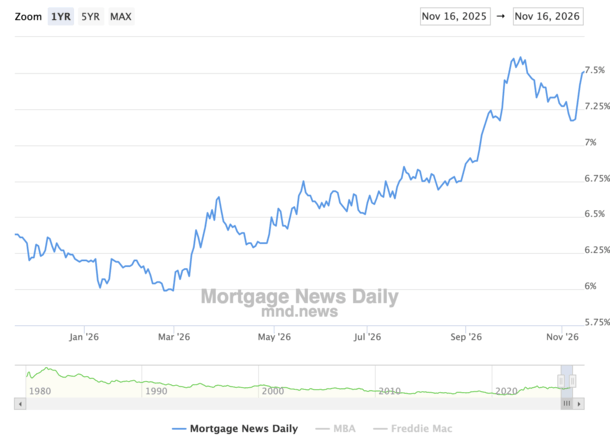
After one of the worst weeks for bonds in years, 30-year fixed mortgage rates are starting a fresh week stuck in the mid-7s.
The 10-year Treasury yield is down a couple ticks, but given the tech stock rout, it’s not offering up a whole lot of relief.
Typically bond yields (and mortgage rates) get help from stock market selloffs, but not so much today.
As such, mortgage rates are probably going to remain around 7.5% or so, and not far from their recent highs of 7.625%.
The question now is how do they get better if tech stocks are no longer helping?
Tech Stocks Are Under Pressure Again, But Mortgage Rates Aren’t Getting Much Help
At last glance, the tech-heavy Nasdaq was nearly 2% lower and the S&P 500 dropped more than 1%, with chip stocks the culprit.
The big story lately has been Nvidia and its embattled CEO Jensen Huang, who is now reportedly considering a return as CEO.
For the record, they report earnings tomorrow after the market close, which could play a major role for mortgage rates.
While the tech selloff didn’t help today, a bigger selloff linked to weak Nvidia earnings could potentially lead to another flight to safety in bonds.
If it does, mortgage rates would be the beneficiary, though the opposite also holds true.
If somehow Nvidia shakes off the recent CEO scandal and delivers hot earnings, we could see a risk-on move back into stocks and away from bonds.
That would result in even higher mortgage rates, which are already not far from recent highs.
The concerning part is Nvidia is already down like 35% from its recent highs and mortgage rates are still quite elevated, only about .125% below recent highs, per MND.
So you wonder how much a stock selloff can really help mortgage rates if it hasn’t done so already.
Fed Chair Warsh Talks AI as It Continues to Be Key Theme
Last week’s bond selloff was driven by economic data, and this week is full of Fed speakers.
This morning, Fed Chair Warsh spoke about AI, saying it could be huge or could be a dud.
One of the things he laid out before becoming the new Fed chair was supposed productivity gains from AI that would lead to disinflation.
Therefore, you could get lower interest rates while seeing economic growth and employment near full capacity.
But now he’s also saying it could “disappoint,” leading to a more near-term economic slowdown with job losses and perhaps a crashing stock market (something I definitely considered as did many others).
So again, AI is a key theme here whether it’s the Fed, the stock market, mortgage rates, or the wider economy.
All eyes seem to be on AI and whether it’s going to live up to its billing.
That’s probably the biggest driver of mortgage rates I’m looking at these days, aside from the major data reports like CPI, monthly jobs, etc.
[Compare mortgage rates and monthly payments side by side with my mortgage rate calculator.]
Oil and the Middle East Remain in the Background
While AI is the central theme of late, we still have elevated oil prices and tensions in the Middle East.
Things have been relatively quiet on that front, but it only takes one bad Iran headline to send oil (and inflation worries) right back up again, putting additional pressure on mortgage rates.
Given mortgage rates are already struggling despite the stock market carnage tells you the pressure is currently upward.
Tomorrow we get October retail sales, which economists expect to be a lot cooler than September’s 0.8% gain (just 0.2%).
If we happen to get a strong number, bond yields could continue to rise more above 5%, while making the case for a larger Fed rate hike next month.
The only real path to mortgage rate relief right now seems to be weak economic data and/or something majorly positive with Iran. Both don’t appear to be happening lately.
Read on: How are mortgage rates determined?

- Mortgage Rates Hold Near 7.5% Despite Tech Stock Slide - November 16, 2026
- Mortgage Rates Climb Back Toward 7.50% as 10-Year Yield Sees Biggest Weekly Jump in Over a Year - November 13, 2026
- More Pain for Mortgage Rates as Bond Yields Jump Back Above 5.10% - November 12, 2026