
Goldman Sachs just put out their 2027 housing outlook and the good news is it has mortgage rates coming down next year.
And by a healthy margin at that, with the popular 30-year fixed sliding to 6.4% at some point.
That’s nearly a full percentage point below current levels, which have hovered around 7.25% to 7.375%.
While it’s a positive, they don’t expect home sales to recover as a result. In fact, they expect an even softer year as home buyers continue to struggle with affordability.
At the same time, refinancing is projected to be weak with the majority of existing homeowners sitting on lower-than-market rates.
The 30-Year Fixed is Forecast to Fall to 6.4% in 2027
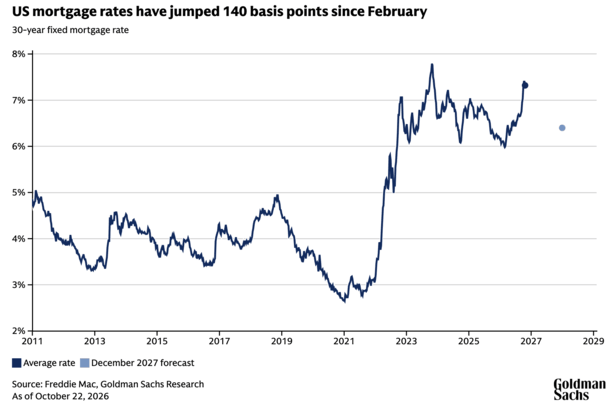
According to Goldman Sachs’ newly-released 2027 housing outlook, its credit strategists expect mortgage rates to decline to 6.4%.
That’s nearly a full point below levels seen when the report was put together at the end of October.
On a $400,000 loan amount, we’re talking about nearly $270 in monthly savings, which is certainly something to get excited about.
However, they do say rates will “remain elevated” at those levels, I suppose relative to where they were in late February and early March of this year (sub-6%).
And they said, “Even if that decline is realized, affordability will remain at historically poor levels.”
So getting back down to the mid-6s on the 30-year fixed merely allows us to keep up the status quo, which is the lowest home sales volume in 30 years.
Of course, this is but one forecast and we all remember how wrong all the forecasts have been the past few years (and the years before that too).
Why Are Mortgage Rates Still Expected to Stay High?
As you might have suspected, Goldman blamed this year’s jump in mortgage rates on the war in Iran, high oil prices, and the prospect of additional Fed rate hikes.
If the war gets resolved and energy prices drop, that could also give the Fed pause to hike again.
So there’s a lot at stake in the Middle East. It kind of dictates much of what’s happening at the moment.
Yes, there is also the AI trade, which is proving to be a tailwind for bonds (and lower mortgage rates) via a flight to safety.
But I don’t know how many people want to see their stock portfolio get pummeled in order to get a slightly lower mortgage rate.
In other words, it’s the same old story since early this year. If you want mortgage rates to improve, you need to root for a resolution in Iran.
The Lock-In Effect Isn’t Going Away
Even if we get back down to 6.4% next year, there’s the matter of mortgage rate lock-in.
In the report, Goldman also noted that more than 95% of existing mortgage borrowers have rates below current market rates.
And 65% have rates that are at least two percentage points (2%) below market rates.
This is what’s known as the mortgage lock-in effect, and it’s why so many homeowners are simply deciding to stay put.
Why give up a 2% to 4% mortgage rate for one that’s more than double that? With a higher home price to boot? And higher property taxes, homeowners insurance, etc.?
That’s why the report is forecasting another year of disappointing home sales.
[See what different mortgage rates actually mean with my mortgage rate calculator.]
Existing Home Sales Below Four Million in 2027
They expect existing home sales to total just 3.9 million in 2027, which is below their forecast of 4 million for this year.
That’s already around 30-year lows, similar to recent prior years. And worse, it’s about 26% below 2019 levels, when the housing market was last considered normal.
That will be hard on the industry, with mortgage lenders already laying off staff, closing shop, etc. Same goes for real estate agents, who are also struggling mightily in this low-transaction environment.
As for home prices, Goldman expects growth that’s “anemic” and below than 1%. Specifically, up just 0.8%, which won’t keep pace with inflation.
That’s slightly below the 1.1% expected in 2026 and the 1.2% we saw in 2025.
So even if mortgage rates move lower from here, it won’t magically fix things. Affordability will remain tough regardless.
But it might be uneven. Goldman expects housing activity to start recovering by the second half of next year if interest rates come down as forecast.
Read on: How are mortgage rates determined?

- Goldman Sachs Sees Mortgage Rates Falling to 6.4% in 2027 - November 3, 2026
- Mortgage Rates Edge Closer to a 6-Handle Ahead of Midterms and Jobs Report - November 2, 2026
- Tech Selloff Keeps Pushing Mortgage Rates Closer to the 6s - October 30, 2026