If you’ve ever looked at a mortgage rate chart, you’ll see that mortgage rates experienced a double-top in the early 1980s.
That’s when mortgage rates hit all-time highs, with the 30-year fixed briefly rising above 18%.
Those are the rates the Boomers always like to bring up when today’s young home buyers complain that rates are too high.
Of course, it’s not apples-to-apples because home prices were much lower then, as was the cost of living.
But if history were to repeat, with a second top this cycle, it’d put the 30-year fixed just shy of 9%.
Mortgage Rates Peaked in 1981
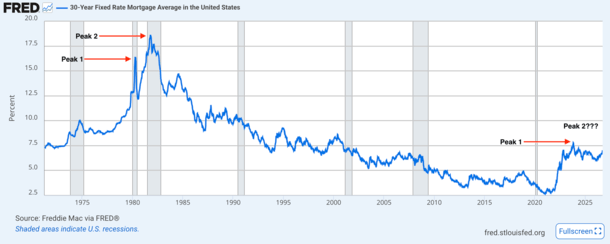
During the week of October 9th, 1981, the 30-year fixed hit its all-time high of 18.63%, per Freddie Mac PMMS data., as seen in this chart from FRED.
But that was actually the second peak of what was a really tough period for inflation and interest rates in the early 1980s.
There was a prior peak of 16.35% seen in mid-April of 1980, before mortgage rates took a breather and looked to be heading down.
If you’re one of those people who believes that history repeats or “rhymes,” you might think we’re headed for a second peak.
So far this cycle, mortgage rates have taken a similar path, rising sharply before coming back down and looking like the worst was over. Then climbing again…
Current Mortgage Rate Peak Is 7.79%
We hit 7.79% at our peak this cycle back in late October 2023, then saw rates drift lower for years after that.
Before the war kicked off in early March, we were back around 6% and even slightly lower.
But that was short-lived, and since then mortgage rates have been surging higher again.
So much so that they’re now the highest they’ve been since early 2024.
Could they make a run toward those late-2023 mortgage rates next? It’s certainly not out of the question and the reason would be fairly similar.
A second wave of inflation, this time driven by the Middle East conflict and the surging cost of oil.
With a massive AI build-out thrown in as well that’s making the economy run hot.
A Similar Move Would Put Us Just Below 9% Mortgage Rates
Now assuming it did happen, and mortgage rates hit a new, higher second peak that was proportional to the 1980s move, the 30-year fixed would land around 8.88%.
Of course, rates could go even higher than that since Freddie Mac’s weekly survey data often misses bigger spikes.
So you might see a 9-handle on daily rate indexes like Mortgage News Daily.
But again, that’s only if this actually transpires and history repeats perfectly.
The somewhat good news is because mortgage rates are so much lower today, the cycle high wouldn’t be anywhere near those 1980s mortgage rates.
We wouldn’t go back to high double-digit rates again, but we would hit new highs for the current cycle.
And that would likely lead to even fewer home sales, which are already bouncing around 30-year lows.
But Would It Be Followed By a Housing Boom?
So it’d be even more bad news for the housing industry, real estate agents, home builders, loan officers, mortgage brokers, etc.
But, it’d also probably be relatively short-lived, and followed by a sharp decline, as parabolic moves higher tend to run out of steam quickly.
While the 30-year fixed was indeed above 18% back then, it fell to 12% about a year and a half later. Talk about some big moves.
In other words, the high mortgage rates didn’t sustain, and relief came pretty swiftly.
That means the silver lining here, even if mortgage rates do rise close to 9% in a second wave scenario, is that it would eventually lead to a period of low rates.
And a major uptick in activity for an industry that has been struggling for years.
Read on: Compare different mortgage rates with my mortgage rate calculator.

- Mortgage Rates Could Top Out at 8.88% If History Repeats - September 29, 2026
- Rocket Mortgage Making the Switch From FICO to VantageScore - September 28, 2026
- What Can Save Mortgage Rates? - September 28, 2026