

After a series of strikes and escalations in the Middle East, it appears mortgage rates might soon match the highs seen since the war began.
The highest point for the 30-year fixed since the Iranian conflict got underway was 6.75% back on May 19th, per Mortgage News Daily.
Since that time, they dropped about 0.25% thanks to a ceasefire and peace deal.
But that has since fallen apart and now mortgage rates are close to testing those highs once again.
However, given a lot is “baked in,” mortgage rates might be somewhat capped at these levels.
Mortgage Rates Approaching War Time Highs
The 30-year fixed has had a rough time since hitting 3.5-year lows back at the end of February.
And it’s pretty much all because of an unexpected conflict that broke out in the Middle East.
Before the U.S. and Israel launched strikes on Iran, the 30-year fixed was at its lowest point since 2022.
If you recall, rates were still in the 3s to start 2022, but quickly doubled as the year went on.
Though we were only able to muster a sub-6% rate back in February of this year, it was the best rate seen since the latter half of 2022.
That was a very bad year for rates, as they more than doubled in a calendar year once QE ended and inflation began to become a major concern.
Still, getting back there was a huge positive after the 30-year fixed climbed as high as 8% in late 2023.
But those late February levels seem like a distant memory now, with the typical mortgage rate quote back in the high 6s.
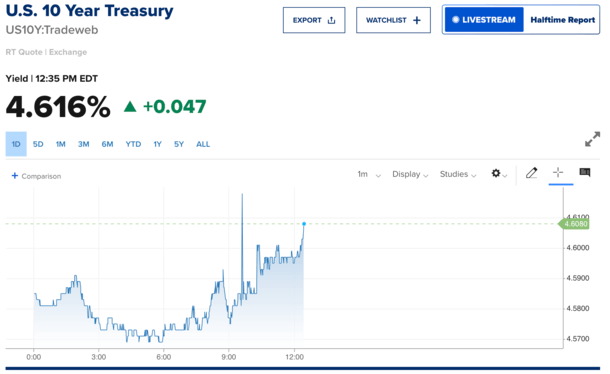
Today, the 10-year bond yield, which acts as a bellwether for mortgage rates, rose above 4.60% again on escalations in the Middle East.
The strikes also caused oil prices to rise about five percent as the Strait of Hormuz saw traffic come to a standstill again.
Long story short, the peace deal appears to be toast and tensions seem to be as high as ever.
The market is responding to that risk by selling off and mortgage rates will suffer as well.
Is a Lot of the Move Higher in Mortgage Rates Already Priced In?
However, it’s important to remember the context here. Much of this is already priced in.
Mortgage rates aren’t back near their pre-war levels. They aren’t sub-6% anymore or close to it.
They are priced for the war and the higher oil prices and the inflation that comes with it.
So despite yet another setback in a seemingly hopeless quest for peace, it’s perhaps not as bad as it looks.
What I mean by that is mortgage rates are basically at the top of their range that includes a war premium.
They were as low as 5.99% per Mortgage News Daily back in late February and as high as 6.85% last July.
At last glance, they are around 6.70%, which means they’re basically at their 52-week highs. Or just about.
One could argue that that’s good news because it means the risks are already priced in.
If rates were still low and we were ignoring the developments in the Middle East, that’d be another story.
But it’s already reflected in the price of a mortgage today. You are no longer able to get a sub-6% 30-year fixed (without paying discount points).
Instead, you’re paying a premium of about 75 basis points (0.75%) versus those pre-war levels.
More Downside Potential for Mortgage Rates Near Their 52-Week Highs
In addition, the market isn’t as spooked or bothered by the goings on in the Middle East anymore.
Traders have seen this movie before, multiple times. As such, further upside risk might be limited, especially when you factor in what’s already baked in to the price.
Conversely, what might surprise traders would be peaceful developments, which could lead to lower mortgage rates again!
Taken together, there might be limited upside risk and more downside potential for mortgage rates, despite current headwinds.
Read on: Try my new mortgage rate calculator to compare different interest rates side by side.

- Mortgage Rates Look Headed Back to War Time Highs - July 13, 2026
- Despite Headwinds, Odds of a 7% 30-Year Fixed in 2026 Are Super Low - July 9, 2026
- Just When You Thought 7% Mortgage Rates Were Off the Table - July 8, 2026