
Opendoor has rolled out a new way to buy a home that bypasses the mortgage entirely.
And that might sound pretty good given where mortgage rates are at these days.
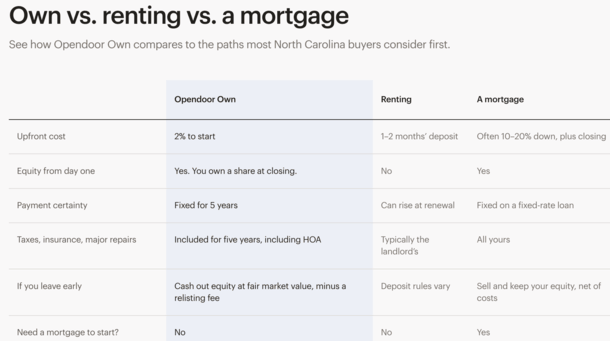
It’s called “Opendoor Own,” and the pitch is 2% down, no mortgage, and a monthly payment that stays fixed for five years.
With rates on the 30-year fixed stuck near 7.5%, that sounds pretty appealing.
But naturally, I have questions.
What Is Opendoor Own?
Opendoor (NASDAQ:OPEN) is an iBuyer. That means they buy and sell homes in expedited fashion and sometimes skip the real estate agent in the process.
So typically when you get a home from them you own it. But this new Opendoor Own program works a little differently.
You don’t own the entire home as you do with the standard Opendoor home buying program. Ownership is fractional.
To get in the door, you’re required to put 2% down, which is $6,000 on a $300,000 home.
Then a co-investor partner funds the rest of the purchase, including any closing costs. You get a slice of the home on day one, and accrue more of it over time.
In other words, it’s a shared equity deal where you and an investor own the property together.
And importantly, Opendoor says it’s not a loan, and that it’s not a commitment to lend.
For now, it’s a North Carolina pilot program for homes priced between $200,000 and $750,000. And the waitlist is already closed.
But perhaps it’ll expand if it proves to be successful.
Initially, they have designed it for home buyers with a minimum 660 credit score and $60,000 in income.
No Mortgage Doesn’t Mean No Cost
Having no mortgage sounds great. But there’s still a cost, obviously.
Your monthly payment actually has two parts here.
One portion earns you more home equity, and the other is an “occupancy fee” that covers taxes, insurance, HOA dues if applicable, and major repairs.
Routine maintenance is still on you as it would be as a full-on homeowner.
An occupancy fee is basically just rent by any other name, and they don’t tell us how much of each payment actually goes toward equity.
That split is the thing to pay attention to here to determine if it’s a good deal.
Opendoor touts $392 a month in average savings versus a conventional mortgage, and $17,000 in equity built after two years.
This is using a $300,000 home purchase I believe.
But the fine print says those figures come from its investor partners, and individual results will vary, etc. etc.
You’ll Probably Build More Equity Faster the Traditional Route
Compare that to a mortgage (let’s say $300,000 home with 3% down and a 7% mortgage rate) and you’d have an outstanding balance of about $285,000 after 24 months.
So assuming we’re comparing the same thing here, and home prices rise say 3% annually, you’d have about $33,000 in equity if you went the mortgage route.
Yes, our example requires an additional one percent down (3% total), but you wind up with more equity versus the Opendoor Own option.
In fact, you’d have about double the amount of equity after just two years.
The big question then becomes, what does the difference in monthly payment look like?
If the Opendoor Own payment is way less than a comparable PITI mortgage payment, it could make some sense.
What Happens When You Want to Buy the Entire House?
The next piece you need to consider is buying the home eventually.
If the monthly payment, which they say is fixed for the first five years actually pencils, you need to look at the buyout price.
You can buy the rest of the home whenever you want, you can leave, or you can renew the fractional arrangement after five years.
So there’s no hard deadline, which is better than a lot of rent-to-own deals.
Assuming you do buy, the fair market value is determined via an average of three independent valuations.
If the home appreciates, it’s good for your share, but also means the remaining portion gets more expensive.
To own the entire house, you’ve got to come up with the rest of the money, which for most people would probably mean, you guessed it, taking out a mortgage!
So you’re not skipping the mortgage issue entirely, just postponing it until you want to buy the whole house.
For the record, you can leave whenever you want, but leaving isn’t free either.
If you decide to move, they cash you out at fair market value at the time minus a relisting fee, which is higher in the first 30 months (there’s no dollar amount given).
The final question becomes, what will mortgage rates be like then? They will be lower, higher, the same? Nobody knows.

- Opendoor Wants to Sell You a Home With 2% Down and No Mortgage. What’s the Catch? - October 26, 2026
- Mortgage Rates Holding Onto Recent Improvement Heading Into Fed Week - October 26, 2026
- Mortgage Rates Back on the Rise After Biggest Bond Rally Since 2023 - October 23, 2026