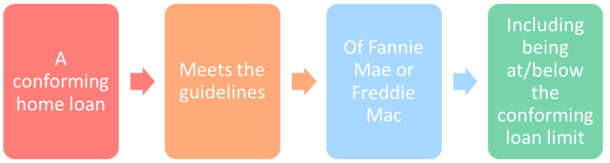
A “conforming mortgage” is a home loan with a loan amount up to $806,500 that also meets the underwriting guidelines set forth by Fannie Mae and Freddie Mac.
This maximum loan amount is up from $766,550 in 2024 after increasing from $726,200 in 2023.
It typically adjusts each year in January, as long as property values increase, based on home price movement during the year prior.
Aside from adhering to maximum loan amounts, conforming loans generally require a minimum FICO score of 620 from all borrowers.
They are the most common type of mortgage, accounting for around half of all home loans originated.
Conforming Home Loan Requirements
- Must meet underwriting guidelines set by Fannie Mae or Freddie Mac
- Including a minimum credit score (generally 620 FICO or higher)
- And a maximum debt-to-income (DTI) ratio of 43%
- Home buyers can obtain a loan with as little as 3% down payment
- Income, assets, and employment will be evaluated for loan approval
- Loan amount must be at/below the conforming loan limit
As noted, conforming home loans adhere to underwriting standards set by Fannie Mae and Freddie Mac.
This includes credit and income requirements, such as a minimum 620 FICO score and full doc underwriting, which considers income, assets, and employment history.
A maximum DTI ratio of 43% is permitted, though ratios up to 50% may be allowed with compensating factors.
Both home buyers and those refinancing an existing mortgage can get a mortgage for up to 97% loan-to-value (LTV).
Conforming loans are subject to loan-level price adjustments (LLPAs), which can affect the mortgage rate offered.
These LLPAs reward borrowers with high credits scores and down payments, allowing them to qualify for lower mortgage rates.
Those with risky attributes may find that rates are better on FHA loans, which don’t have pricing adjustments.
One big perk to a conforming loan is that mortgage insurance isn’t required if you put down a 20% down payment.
Tip: If your FICO score is below 620, you may need to seek out a portfolio lender or look to government loan programs instead like FHA/VA/USDA.
Conforming Mortgage Rates Are Typically the Lowest Available
- Conforming loans are the most popular mortgages available
- This allows lenders to offer the lowest mortgage rates on such loans
- Interest rates should be cheaper than jumbo loans and other non-conforming loans
- If possible try to keep your home loan in the conforming realm for best pricing
Conforming loans tend to carry lower mortgage rates than jumbo loans (those above the conforming loan limit).
This is the result of the many rules lenders must follow to originate one, resulting in strong investor demand.
In other words, you should be able to get a cheaper mortgage rate, all else being equal, if your home loan conforms to Fannie Mae and Freddie Mac’s standards.
For this reason, borrowers will often put more money down to stay under the conforming loan limit. Or take out a combo loan and keep the first mortgage in conforming loan territory.
Doing so will allow them to get a lower interest rate and/or expand their financing options as more lenders out there offer conforming loans than jumbo loans.
The rate you receive will be determined by LLPAs associated your loan. Those with 780 FICO scores are eligible for the lowest rates.
Conversely, those with scores between 620-639 will be subject to the highest rates. So be sure to focus on your scores before you apply.
Credit score is perhaps one of their most important qualifying criterion other than loan size.
If the loan amount exceeds the loan limit (jumbo loan) or doesn’t meet the guidelines of Fannie or Freddie, it is known as a non-conforming loan.
When Does the Conforming Loan Limit Change?
- The conforming loan limit can go up each year (but never down)
- Any upcoming changes are announced in November
- Based on October-to-October home price movement from the FHFA
- New loan limits go into effect the following January 1st
The conforming loan limit changes annually, as determined by the FHFA, based on October-to-October home price data. It is announced in November and goes into effect the following January.
It can only go up, not down. If home prices fall year over year, it will remain unchanged until those declines have been made up.
The Emergency Home Finance Act of 1970 originally established a conforming loan limit of $33,000 for Fannie Mae and Freddie Mac.
Congress later raised the conforming limit to $60,000 for mortgages originated in 1977, and pushed it to $67,500 in 1979.
Not long after, the Housing and Community Development Act of 1980 increased the loan limit to $93,750 and tied future increases to changes in national home prices.
This legislation also established loan limits for two, three, and four-unit properties.
The conforming loan limit has risen substantially in the past thirty years as home prices have skyrocketed in the United States.
But a good chunk of mortgages in major metropolitan areas are still designated as jumbo loans because the data tends to lag.
Below are the 2025 conforming loan limits for properties in the contiguous United States:
One-unit properties: $806,500
Two-unit properties: $1,032,650
Three-unit properties: $1,248,150
Four-unit properties: $1,551,250
*For one-unit properties in Alaska, Hawaii, Guam, and the U.S. Virgin Islands, the conforming loan limit is $1,209,750 which is 50% higher than the baseline.
High-Cost Loan Limits for Conforming Loans
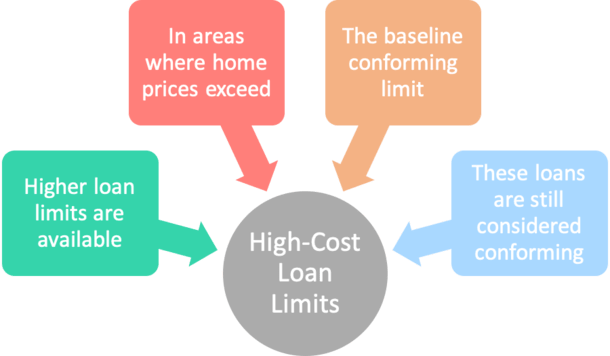
- Fannie and Freddie also have high-cost loan limits that exceed the baseline loan limit
- They only apply in certain expensive counties throughout the country
- Can be as high as 150% of the baseline limit, or $1,209,750 as of 2025
- These loan amounts exceed the conforming loan limit but aren’t considered jumbo loans
The Economic Stimulus Act of 2008 temporarily increased the conforming loan limit in high-cost areas, pushing it to as much as $822,375 in expensive metropolitan areas of the United States such as Los Angeles.
The loan limits were increased because lenders were only making loans backed by Fannie and Freddie (which carry an implicit government guarantee) after the mortgage crisis wiped away private capital.
In other words, it didn’t make much sense to originate a jumbo loan, as it carried far too much risk. So these higher limits ensured lenders could sell off their loans and continue lending.
These limits stayed in place until September 30, 2011, at which point the Housing and Economic Recovery Act (HERA) “permanent” loan limits kicked in. That maxed out at $822,375 in the contiguous United States.
To come up with the high-cost loan limits, the area loan limit is set at 115% of the median home value, up to 50% above the baseline limit.
These types of loans are often referred to as “high balance loans” because they conform to Fannie and Freddie’s standards despite being over the traditional conforming loan limit.
Below are the 2025 high-cost loan limits for properties in the contiguous United States:
One-unit properties: $1,209,750
Two-unit properties: $1,548,975
Three-unit properties: $1,872,225
Four-unit properties: $2,326,875
*These are also the baseline loan limits in Alaska, Hawaii, Guam, and the U.S. Virgin Islands as they do not have high-cost areas.
Conforming Loan Limit History
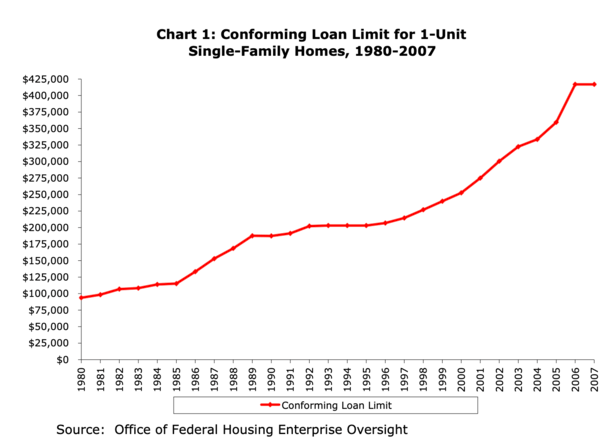
The conforming loan limit has increased tremendously since it was first established via the Emergency Home Finance Act of 1970.
At that time, a loan limit of $33,000 was implemented for both Fannie Mae and Freddie Mac.
But it didn’t last long. In 1977, Congress raised this limit to $60,000 for and by 1979 it was an even higher $67,500.
Then the Housing and Community Development Act of 1980 increased the loan limit ceiling to $93,750 while also indexing future annual increases to changes in average home prices (this is still how it works).
At the same time, separate loan limits were introduced for two-, three-, and four-unit properties.
So for 1980, you had a loan limit of $120,000 for a duplex, $145,000 for a triplex, and $180,000 for a fourplex.
These loan limits basically doubled by the year 1990, and again by 2005, around the time the housing market was reaching maximum bubble territory.
And in 2006, the loan limit reached $417,000, which is a memorable one because it remained there for more than a decade.
As for why, it was because the conforming loan limit cannot decrease, per the Housing and Economic Recovery Act of 2008 (HERA).
Once home prices began ascending again, loan limits quickly increased and basically doubled again to $806,500 as of the year 2025.
Use a Combo Loan to Stay Under the Conforming Loan Limit
- Some savvy borrowers will break their loan amount into two to stay conforming
- This results in a first and second mortgage instead of just a single loan
- May result in a lower interest rate thanks to a lower LTV and a conforming loan amount
- So keeping your first mortgage at/below the conforming loan limit could save you money
Homeowners can avoid exceeding the conforming limit by breaking their loan up into a first and second mortgage, known as a combo mortgage.
For example, if you keep your first loan amount at $806,500 (or $1,209,750 in a high-cost area), you can add a second mortgage behind it without breaking the conforming limit.
Just keep in mind that second mortgages typically come with much higher mortgage rates than first mortgages. And may be subject to their own set of closing costs and fees.
You may also have to deal with two different lenders at once, which can be challenging.
Another way to avoid going jumbo is to put more money down (if you’re able to), or simply buy “less house.”
Be sure to explore all options if your loan amount is close to the conforming limit as it could save (or cost) you quite a bit of money.

- UWM Launches Borrower-Paid Temporary Buydown for Refinances - July 17, 2025
- Firing Jerome Powell Won’t Benefit Mortgage Rates - July 16, 2025
- Here’s How Your Mortgage Payment Can Go Up Even If It’s Not an ARM - July 15, 2025
What is the conforming loan limit in California?
It depends on the city. In high-cost regions like the Bay Area and Los Angeles it’s $625,500, but it’s as low as $417,000 in many cheaper parts of the state.
I’ve heard Jumbo loans are cheaper than conforming loans nowadays. So does it really matter if my loan amount exceeds the conforming loan limit?
This might be true in certain situations, but jumbo lenders are very strict underwriting guidelines, such as massive down payment and asset requirements and very high credit score thresholds. So even if the interest rate is indeed lower, it might be a lot more difficult to qualify. At the end of the day, a conforming loan is the easiest and generally cheapest to acquire.
Curious to hear if Colin Robertson has a different opinion for 2021 for the conforming mortgage limit going up (the trend for the last few years) or going down … given the current COVID-19 times will have on real estate values nationally.
Ray,
It’ll probably still go up, though maybe marginally, because it’s based on October to October home price growth, which will likely be up from a year ago.
What are your thoughts now? Do you think they will still increase?
Yes, it’s all based on home price data. Prices have gone up again, despite COVID, so we should see an increase in the conforming loan limit.
By what percentage do you believe it will increase? Will we see around a 5% increase?
Michael,
At the moment, it’s looking more like a 7% or so increase from last year, based on home price data thus far.
When will 2021 conforming adjustments be announced?
Shannon,
Should be a news release the last week of November, so about two weeks away.
Do you think covid could deter them from raising the max? Or do you think they will look at sales as usual?
I don’t think COVID will play a role either way – believe it’s data driven, not subjective.
This author is expecting a new limit of ~$539,000, up 5.6%. It appears based on comments here that this is likely?
I cannot take advantage of these low rates until I’m able to get out of my jumbo loan and a higher limit will help me get there soon.
David,
Yes, I trust their estimate, especially since home price gains have accelerated even more in the second half of 2020. Just keep in mind mortgage rates can rise between now and next year, so you could always shop lenders now to see who is competitive on jumbo or conforming-jumbo loans just to be sure.