When shopping for a home loan, you may come across the term “risk-based pricing”.
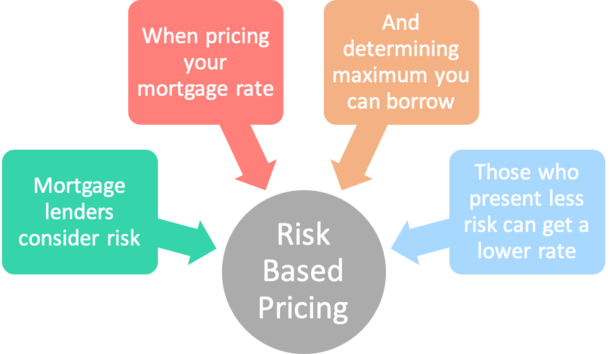
It’s a method the mortgage industry uses to measure risk and deliver appropriate interest rates based on a borrower’s ability to repay their loan.
To mitigate the risk of default, banks and mortgage lenders have created pricing adjustments for a variety of loan criteria.
In simple terms, a borrower deemed more risky by a bank or lender will receive a higher mortgage interest rate to offset the greater probability of default.
Conversely, a more qualified borrower will be granted a lower interest rate seeing that there’s a smaller chance of them actually missing a mortgage payment.
Less Risk = Lower Mortgage Rate
- Mortgage lenders use risk-based pricing
- Which means the less risk you present to the lender
- The lower your interest rate will be
- The opposite is also true
There are a number of risk-based factors that can affect the pricing of your home loan.
One of the most important factors will always be credit score. FICO scores range from 300-850, and can greatly impact the interest rate you ultimately receive.
Credit scores of 760 and above are generally considered to be in the highest tier, and may result in a pricing incentive.
Look at this example of risk-based pricing:
FICO score ≥740 score = .375% rebate
FICO score 680-739 = no fee/rebate
FICO score 660-679 = .25% cost
As you can see, FICO scores of 740 and above receive a “rebate” of .375%, while scores between 660-679 are slapped with a .25% “cost.” These costs or rebates associated with each rate are known as adjustments to fee.
If your rebates outweigh your costs, you’ll wind up with a lower interest rate or a lender credit, the latter being something you can use to offset any closing costs.
Simply put, the more pricing rebates you receive, the lower your interest rate should be.
However, if your loan is riddled with costs for things like a low credit score, a high LTV, or a multi-unit property, your mortgage rate will be higher to compensate.
Note that credit scores between 680 and 739 weren’t assigned a cost or a rebate because they’re all in all pretty average.
More Risk = Less Credit
- If your mortgage loan is particularly risky
- You’ll get hit with more pricing adjustments
- Which will result in a higher interest rate
- Or more closing costs that must be paid out-of-pocket
Let’s pretend a 6% mortgage rate has a base rebate of .625%. Using our example from above, a 760 FICO score would raise the total rebate to 1%, and a score between 660-679 would lower the rebate to .375%.
This net rebate is the actual yield spread premium (or commission) the broker or bank used to receive for closing your loan. It is now your lender credit.
Assuming your loan amount is $300,000, the 1% credit would equate to $3,000 that could be used to pay closing costs. So if your total loan costs were $5,000, only $2,000 would need to be paid out-of-pocket.
Conversely, if you had a lower credit score and only received .375% back from the lender, the credit would drop to $1,125.
This means you’d have to come out-of-pocket $3,875 to cover closing costs, or alternatively go with a slightly higher interest rate to increase your credit.
For example, an interest rate of 6.25% might yield that 1% credit you want/need to get $3,000 in credit.
In other words, a borrower with a higher FICO score will be able to secure a larger credit, so they won’t need to pay as much (if anything) upfront. Or they’ll be able to obtain a lower mortgage rate.
Conversely, a borrower with excessive adjustments on their home loan will likely have to raise their interest rate to obtain a larger credit, or simply pay more out-of-pocket at closing.
Or you’ll be charged a greater number of upfront mortgage points to buy down your interest rate to a desirable level.
In summary, the more costs associated with your loan, the less rebate your broker or bank will be able to give you, and the higher the mortgage rate will have to be to ensure they get paid to fund your loan.
That is, unless you agree to pay for the loan costs upfront instead. Either way, the more risk you present to the lender, the more you must pay. Period.
So do your best to keep the risk low and you’ll be rewarded with the lowest interest rates available. You know, the ones you see advertised…
For more information related to risk-based pricing, see my page on mortgage pricing adjustments.

- UWM Launches Borrower-Paid Temporary Buydown for Refinances - July 17, 2025
- Firing Jerome Powell Won’t Benefit Mortgage Rates - July 16, 2025
- Here’s How Your Mortgage Payment Can Go Up Even If It’s Not an ARM - July 15, 2025