

Trade In Your Old Home Loan for a New One
Fundamental mortgage Q&A: “How does mortgage refinancing work?”
When you refinance a mortgage, you trade in your old home loan for a new one in order to get a lower interest rate, cash out of your home, and/or to switch loan programs.
In the process, you’ll also wind up with a new mortgage term, and possibly even a new loan balance if you elect to tap into your home equity.
You may choose to obtain this new mortgage from the same bank (or loan servicer) that held your old loan, or you may refinance your home loan with an entirely different lender. That choice is up to you.
It’s certainly worth your while to shop around if you’re thinking about refinancing your mortgage, as your current lender may not offer the best deal.
I’ve seen first-hand lenders try to talk their existing customers out of a refinance simply because there wasn’t an incentive for them. So be careful when dealing with your current lender/servicer.
Anyway, the bank or mortgage lender that funds your new mortgage pays off your old loan balance with the proceeds from the new loan, thus the term refinancing. You are basically redoing your loan.
In a nutshell, most borrowers choose to refinance their mortgage either to take advantage of lower interest rates or to access equity they’ve accrued in their home.
Two Main Types of Mortgage Refinancing
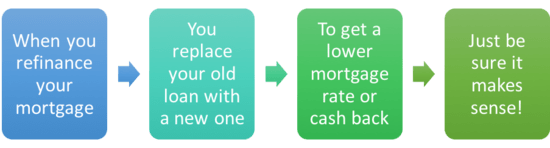
As noted, a mortgage refinance is essentially a trade-in of your existing home loan for a new one. You are under no obligation to keep your loan for the full term or anywhere near it.
Don’t like your mortgage? Simply refi it and get a new one, simple as that. And by simple, I mean qualifying for a mortgage again and going through a very similar process to that of obtaining a home purchase loan.
You can check out my article about the mortgage refinance process to see how it works, step-by-step.
It’ll take about a month to six weeks and will feel very much like it did when you purchased a home with a mortgage.
You’ll typically need to provide income, asset, and employment information to the new lender. And they will pull your credit report to determine creditworthiness, along with ordering an appraisal (if necessary).
Now assuming you move forward, there are two main types of refinancing options; rate and term and cash-out (click the links to get in-depth explanations of both or continue on reading here).
Rate and Term Refinancing (To Get a Lower Rate or Change Programs)
- Loan amount stays the same
- But the interest rate is typically reduced
- And/or the loan program is changed
- Such as going from an ARM to a fixed-rate mortgage
- Or from a 30-year fixed to a 15-year fixed loan
- Or FHA to conventional
- You obtain a new interest rate and loan term (even a fresh 30 years if wanted)
Let’s start with the most basic type of mortgage refinance, the rate and term refinance.
If you don’t want any cash out, you’ll simply be looking to lower your interest rate and possibly adjust the term (duration) of your existing loan.
This type of transaction is also known as a limited cash-out refinance or a no cash-out refinance.
The takeaway is that your loan amount stays basically the same, but your financing terms change.
Let’s look at an example:
Original mortgage: $300,000 loan balance, 30-year fixed @ 6.50%
New mortgage: $270,000 loan amount, 15-year fixed @ 4.50%
Simply put, a rate and term refinance is the act of trading in your old mortgage(s) for a new shiny one without raising the loan amount.
As noted, the motivation to do this is typically to lower your interest rate and possibly shorten the term in order to save on interest.
Or to change products, such as moving from an adjustable-rate mortgage to a more secure fixed-rate mortgage.
In my example above, the refinance results in a shorter-term mortgage and a substantially lower interest rate. Two birds, one stone.
And the loan amount is smaller because you may have taken out the original loan seven years ago. So we need to account for principal pay down between the date of origination and the time of refinance.
In any case, thanks to the lower rate and shorter loan term, it will be paid off faster than scheduled and with far less interest. Magic.
Here’s a more in-depth example with monthly payments included:
Original loan amount: $300,000 (outstanding balance $270,000 after seven years)
Existing mortgage rate: 6.5% 30-year fixed
Existing mortgage payment: $1,896.20
New mortgage rate: 4.5% 15-year fixed
New mortgage payment: $2,065.48
In this scenario, your new loan amount will be whatever the loan was paid down to prior to the refinance. In this case it was originally $300,000, but paid down to $270,000 over seven years.
You’ll also notice that your interest rate drops two percentage points and your mortgage term is reduced from 30 years to 15 years (you could go with another 30-year loan term if you chose).
As a result of the refinance, your monthly mortgage payment increases nearly $170.
While this may seem like bad news, it’ll mean much less will be paid in interest over the shorter term and the mortgage will be paid off a lot quicker. We’re talking 22 years instead of 30.
If the timing is right, it might be possible to shorten your loan term and reduce your monthly payment!
Tip: Should I use my current lender to refinance my mortgage?
Consider the Loan Term When Refinancing
For those who don’t want a mortgage hanging over their head for 30 years, the use of a rate and term refinance illustrated above can be a good strategy.
Especially since the big difference in interest rate barely increases the monthly payment.
But you don’t need to reduce your loan term to take advantage of a rate and term refinance.
You can simply refinance from one 30-year fixed into another 30-year fixed, or from an adjustable-rate mortgage into a fixed mortgage to avoid an upcoming rate adjustment.
Some lenders will also let you keep your existing term, so if you’re three years into a 30-year fixed, you can get a new mortgage with a 27-year term. You don’t skip a beat, but your payment drops.
If you go with another 30-year loan term, the refinance will generally serve to lower monthly payments, which is also a common reason to refinance a mortgage.
Many homeowners will refinance so they can pay less each month if they’re short on funds, or wish to put their money to work elsewhere, such as in another, higher-yielding investment.
So there are plenty of options here – just be sure you’re actually saving money by refinancing, as the closing costs can eclipse the savings if you’re not careful.
A Mortgage Refinance Isn’t Always About the Interest Rate
As you can see, reasons for carrying out this type of refinancing are plentiful.
While securing a lower interest rate may be the most common, there can be other motivations.
They include moving out of an adjustable-rate mortgage into a fixed-rate mortgage (or vice versa), going from an FHA loan to a conventional loan, or consolidating multiple loans into one.
And in our example above, to reduce the loan term as well (if desired) in order to pay down the loan faster.
See many more reasons to refinance your mortgage, some you may have never thought of.
In recent years, a large number of homeowners went the rate and term refi route to take advantage of the unprecedented record low mortgage rates available.
Many were able to refinance into shorter-term loans like the 15-year fixed mortgage without seeing much of a monthly payment increase (or even a decrease) thanks to the sizable interest rate improvement.
Obviously, it has to make sense as you won’t be getting any cash in your pocket (directly) for doing it, but you will pay closing costs and other fees that must be considered.
So be sure to find your break-even point before deciding to refinance your existing mortgage rate. This is essentially when the upfront refinancing costs are “recouped” via the lower monthly mortgage payments.
If you don’t plan on staying in the home/mortgage for the long-haul, you could be throwing away money by refinancing, even if the interest rate is significantly lower.
[How quickly can I refinance?]
Cash-Out Refinancing (To Tap Equity and Maybe Get a Lower Rate Too!)
- The loan amount is increased as a result of home equity being tapped
- The funds can be used for any purpose you wish once the loan closes
- May also result in a lower interest rate and/or product change
- But monthly payment could increase thanks to the larger loan amount
- You may also choose a new loan term (e.g. 15 or 30 years)
Original mortgage: $300,000 loan balance, 30-year fixed @6.25%
New mortgage: $350,000 loan amount, 30-year fixed @4.75%
Now let’s discuss a cash-out refinance, which involves exchanging your existing home loan for a larger mortgage in order to get cold hard cash.
This type of refinancing allows homeowners to tap into their home equity, assuming they have some, which is the value of the property less any existing mortgage balances.
Let’s pretend the borrower from my example has a home that is now worth $437,500, thanks to healthy home price appreciation over the years.
If their outstanding loan balance was $300,000, they could pull out an additional $50,000 and stay below that all-important 80% loan-to-value (LTV) threshold.
The cash out amount is simply added to the existing loan balance of $300,000, giving them a new loan balance of $350,000.
What’s really cool is the mortgage payment would actually go down by about $25 in the process because of the large improvement in interest rates.
So even though the borrower took on more debt via the refinance, they’d actually save money each month relative to their old loan payment.
Now a more in-depth example:
Loan amount: $200,000
Existing mortgage rate: 6.5% 30-year fixed
Existing mortgage payment: $1,264.14
Cash out amount: $50,000
New loan amount: $250,000
New mortgage rate: 4.25% 30-year fixed
New mortgage payment: $ 1,229.85
In this scenario, you’d refinance from a 30-year fixed into another 30-year fixed, but you’d lower your mortgage rate significantly and get $50,000 cash in your pocket (less closing costs).
At the same time, your monthly mortgage payment would actually fall $35 because your former interest rate was so high relative to current mortgage rates.
While this all sounds like good news, you’ll be stuck with a larger mortgage balance and a fresh 30-year term on your mortgage.
You basically restart the clock on your mortgage and are back to square one.
Cash Out Will Typically Slow Loan Repayment
If you’re looking to pay off your mortgage in full some day soon, the cash out refi probably isn’t the best move.
But if you need cash for something, whether it’s for an investment or to pay off other more expensive debt, it could be a worthwhile decision.
In short, cash out refinancing puts money in the pockets of homeowners, but has its drawbacks because you’re left with a larger outstanding balance to pay back as a result (and there are also the closing costs, unless it’s a no cost refi).
While you wind up with cash, you typically get handed a more expensive monthly mortgage payment unless your old interest rate was super high.
In our example, the monthly payment actually goes down thanks to the substantial rate drop, and the homeowner gets $50,000 to do with as they please.
While that may sound great, many homeowners who serially refinanced in the early 2000s found themselves underwater on the mortgage, or owing more on their loan than the home was worth, despite buying properties on the cheap years earlier.
This is why you have to practice caution and moderation. For example, a homeowner might pull cash out and refinance into an ARM, only for home prices to drop and zap their remaining equity, leaving them with no option to refinance again if and when the ARM adjusts higher.
Simply put, if you pull cash out it has be paid back at some point. And it’s not free money. You must pay interest and closing costs so make sure you have a good use for it.
Tip: There is also a cash-in refinance, where the borrower brings money to the table instead of taking it out, in order to reduce the loan amount. This can save a deal or make it more attractive at a lower LTV.
How Are Refinance Mortgage Rates?
- If your transaction is simply a rate and term refinance it should be priced similarly to that of a home purchase loan
- The only difference might be slightly higher closing costs (though some banks do advertise lower rates on purchases)
- If you request cash out with your refinance additional pricing adjustments will likely apply
- These could increase your interest rate, perhaps substantially
Now let’s talk about refinance mortgage rates for a moment. When filling out a loan application or a lead form, you’ll be asked if it’s a purchase or a refinance. And if it’s the latter, if you want additional cash out.
For most lenders, a home purchase and rate and term refinance will be treated the same in terms of interest rates.
There shouldn’t be additional pricing adjustments just because it’s a refinance, though closing costs could be slightly higher.
Arguably, refinances could be viewed as less risky than home purchase loans because they involve existing homeowners who are typically lowering their monthly payments or switching from an ARM to a fixed-rate loan product.
Don’t expect a discount though. Just be happy there isn’t an add-on cost for it not being a purchase. And know that some big banks tend to charge more for refis.
When it comes to cash-out refinances, there are typically additional pricing adjustments that increase the interest rate you will ultimately receive.
This means instead of receiving a 6.25% mortgage rate, you may be stuck with a rate of 7% or higher depending on the loan scenario.
If you have a low credit score, a high loan-to-value ratio (LTV), and want cash out, your mortgage rate could skyrocket, as the pricing adjustments are quite hefty with that risky combination.
In addition, qualifying for a cash-out refinance will be more difficult because the larger loan amount will raise your LTV and put increased pressure on your debt-to-income ratio.
In summary, be sure to do the math and plenty of shopping around to determine which type of refinance is best for you.
Refinancing Your Mortgage May Not Be Necessary
- It’s not always the right move depending on your current situation
- And your future plans (if you plan on selling your home relatively soon)
- It can also reset the clock on your mortgage payoff and slow down repayment
- So be sure it makes sense before you spend any time or money on it
Despite what the banks and lenders might be chirping about, refinancing isn’t always the winning move for everyone.
In fact, it could actually cost you money if you don’t take the time to crunch the numbers and map out a plan.
If you’re not sure you’ll still be in your home next year, or even just a few years from now, a refinance might not make sense financially if you don’t recoup the associated closing costs.
This is especially true if you decide to pay mortgage points at closing, which can amount to thousands of dollars.
Instead of borrowing more than you need, or adding years to your loan term, do the math first to determine the best move for your unique situation.
My refinance calculator might be helpful in determining what makes sense depending on the scenario in question.
One alternative to refinancing your existing home loan, especially if you already have a low rate, is to take out a second mortgage, often in the form of a home equity loan or home equity line of credit.
This keeps the first mortgage intact if you’re happy with the associated interest rate and loan term, but gives you the power to tap into your home equity (get cash) if and when necessary.
But as we saw in my example above, it’s sometimes possible to get a lower mortgage payment and cash out at the same time, which is hard to beat. Just remember to factor in the cost of the refinance.
Read more: When to refinance your mortgage.

- UWM Launches Borrower-Paid Temporary Buydown for Refinances - July 17, 2025
- Firing Jerome Powell Won’t Benefit Mortgage Rates - July 16, 2025
- Here’s How Your Mortgage Payment Can Go Up Even If It’s Not an ARM - July 15, 2025