The Mortgage Rates Puzzle
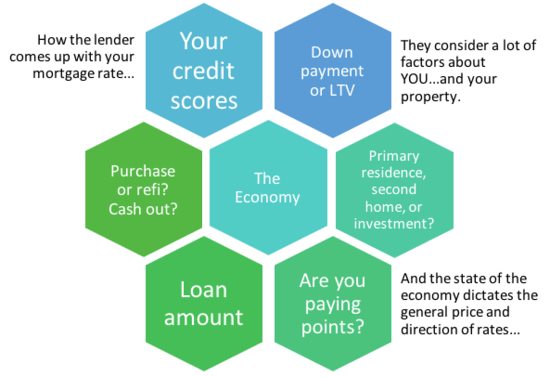
- A lot of factors go into determining your mortgage rate
- Things like credit score are huge (if not the most important)
- As are down payment, property type, and transaction type (refi vs. purchase)
- Along with any points you’re paying to obtain said rate
- The state of the economy will also come into play
- This means there are some things you can control, and others you cannot
If you do a web search for “mortgage rates” you’ll likely see a list of interest rates from a variety of different banks and lenders.
Unfortunately, this won’t tell you much without actually knowing why the rates are what they are and if they’re actually available to YOU.
It’s really just a bunch of numbers on a page. Shouldn’t you know how lenders come up with them before you start shopping for a home loan and buying real estate?
Simply put, the more you know, the better you’ll be able to negotiate! Or call out the nonsense…
Many homeowners tend to just go along with whatever their bank or mortgage broker puts in front of them, often without researching mortgage lender rates or inquiring about how it all works.
Whether you’re interested in rates or not, it’s wise to get a better understanding of how mortgage rates move and why.
One of the most important aspects to successfully obtaining a mortgage is securing a low interest rate. After all, the lower the rate, the lower the mortgage payment each month.
And if your loan term lasts for 360 months, you’re going to want a lower payment. If you don’t believe me, plug some rates into a mortgage calculator.
Jump to mortgage rate topics:
– How Mortgage Rates Are Set
– Are Mortgage Rates Going Up or Down?
– 10-Year Bond Yield vs. Mortgage Rates
– The Economy and Interest Rates
– Mortgage Rates vs. Jobs Report
– Other Factors That Move Mortgage Rates
– How You and Your Property Affect Rates
– Weekly Mortgage Rate Survey Results
– Record Low Mortgage Rates
– Mortgage Rate Predictions for 2026/2027
– Mortgage Rate FAQ
To put it in perspective, a change in rate of a mere .125% (eighth percent) or .25% (quarter percent) could mean thousands of dollars in savings or costs annually. And even more over the entire term of the loan.
Mortgage rates are offered in eighths.
- Mortgage rates are generally offered in eighths
- If it’s not a whole number like 4% or 5%
- Expect something like 4.125% or 5.25%
- Or a promotional rate ending in .99%
One thing I’d like to point out first is that mortgage interest rates move in eighths.
In other words, when you’re ultimately offered a rate, it will either be a whole number, such as 5%, or 5.125%, 5.25%, 5.375%, 5.5%, 5.625%, 5.75%, or 5.875%. The next stop after that is 6%, then the process repeats itself.
4% 4.125% 4.25% 4.375% 4.5% 4.625% 4.75% 4.875% 5%
When you see rates advertised that have a funky percentage, something like 4.86%, that’s the APR, which factors in some of the costs of obtaining the loan.
Same goes for quintessential promo rates like 4.99% or 5.99%, which again factor in costs and are presented that way to entice you.
Those popular surveys also use average rates, which don’t tend to fall on the nearest eighth of a percentage point. Again, these are averages, and not what you’d actually receive.
Your actual mortgage rate will be a whole number, like 5% or 6%, or fractional, with some number of eighths involved. That’s just how mortgage interest rates operate.
However, there are some lenders that may offer a promotional rate such as 4.99% instead of 5% because it sounds a lot better…doesn’t it?
If you want to compare these seemingly tiny differences in rate, check out my mortgage rate calculator. It allows quick comparisons to nearby rates.
Either way, when using loan calculators be sure to input the correct rate to ensure accuracy.
So, how are mortgage rates set?
- There are a variety of factors involved, including the state of the economy
- Related bond yields like the 10-year Treasury
- And lender and investor appetite for mortgage-backed securities (MBS)
- Your borrower/property-specific loan attributes will also come into play
Now’s let discuss how mortgage rates are determined.
Although there are a variety of different factors that affect interest rates, the movement of the 10-year Treasury bond yield is said to be the best indicator to determine whether mortgage rates will rise or fall. But why?
Well, even though most mortgages are packaged as 30-year products, most commonly the 30-year fixed, the average mortgage is actually paid off or refinanced within 10 years.
Homeowners don’t tend to keep their loans until maturity for one reason or another. So the 10-year bond can be a great bellwether to gauge the direction of interest rates on home loans, at least in terms of maturity.
Treasuries are also backed by the “full faith and credit” of the United States, making them the benchmark for many other bonds as well.
Additionally, 10-year Treasury bonds, also known as Intermediate Term Bonds, and long-term fixed mortgages, which are packaged into mortgage-backed securities (MBS), compete for the same investors because they are fairly similar financial instruments.
However, there’s one key difference. Treasuries are 100% guaranteed to be paid back on schedule, while mortgage-backed securities are not, for reasons such as payment default and early repayment.
As a result, mortgage bonds carry more risk and must be priced higher to compensate investors. We’ll discuss that in a moment.
[Mortgage rates vs. home prices]
How will I know if mortgage rates are going up or down?
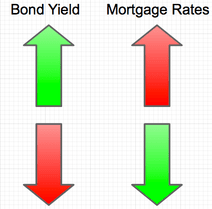
- Here’s a fairly simple way to guess the direction of mortgage rates
- Just look at the current yield on the 10-year Treasury and its recent trend
- If it goes up (or has been rising), expect mortgage rates to rise
- If it goes down (or has been falling), expect mortgage rates to drop
Typically, when bond rates (also known as the bond yield) go up, interest rates go up as well. And vice versa. Don’t confuse this with bond prices, which have an inverse relationship with interest rates.
Investors turn to bonds as a safe investment when the economic outlook is poor. When purchases of bonds increase, the price rises and the associated yield falls, and so do mortgage rates.
But when the economy is expected to do well, investors jump into stocks, forcing bond prices lower and pushing the yield (and interest rates) higher to attract buyers.
10-Year Bond Yield vs. Mortgage Rates
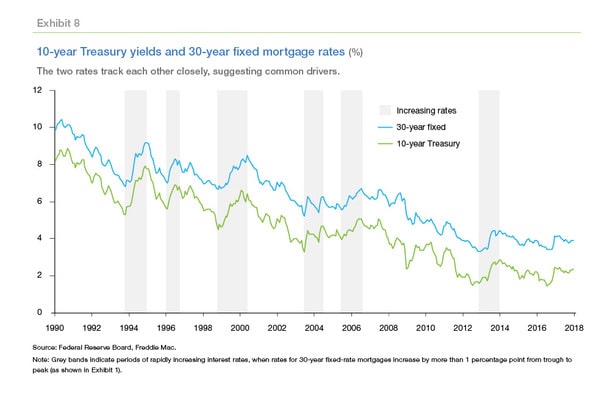
– If 10-year bond yield up, mortgage rates up.
– If 10-year bond yield down, mortgage rates down.
A good way to predict which way mortgage rates are headed is to look at the 10-year bond yield.
You can find it on finance websites alongside other stock tickers, or in the newspaper. If it’s moving higher, mortgage rates probably are too. If it’s dropping, mortgage rates may be improving as well.
To get an idea of where 30-year fixed rates will be, use a spread of about 170 basis points, or 1.70% above the current 10-year bond yield.
This spread accounts for the increased risk associated with a mortgage vs. a government bond, the latter being guaranteed.
So a 10-yr bond yield of 4.00% plus the 170 basis points would put mortgage rates around 5.70%. Of course, this spread can and will vary over time, and is really just a quick way to track mortgage interest rates.
There have been, and will be periods of time when mortgage rates rise faster than the bond yield, and vice versa. So just because the 10-year bond yield rises 20 basis points (0.20%) doesn’t mean mortgage rates will do the same.
In fact, mortgage rates could rise 25 basis points, or just 10 bps, depending on other market factors.
As of early 2026, the spread between 30-year mortgage rates and 10-year treasury yields is back in normal range around 180 bps. In 2023/2024 it was as high as 325 bps, which partially explained why mortgage rates were so high back then!
This means investors are demanding higher yields in exchange for buying higher-risk MBS. Mortgage spreads tend to widen during times of economic uncertainty, or when there’s increased prepayment risk.
Economic activity impacts mortgage rates.
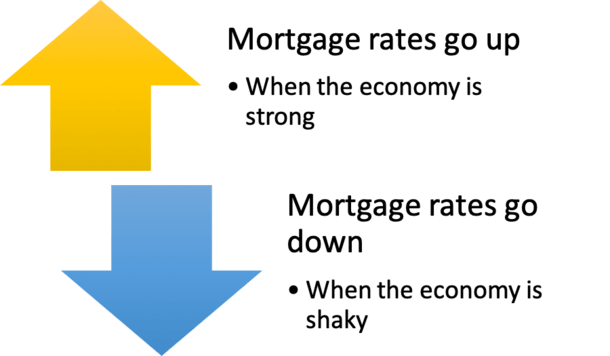
- Keep an eye on the economy as well to determine mortgage rate direction
- If things are humming along nicely, mortgage rates may rise
- But if there’s fear and despair out there, low rates may be the silver lining
- This all has to do with inflation or a lack thereof
Mortgage interest rates are very susceptible to economic activity, just like treasuries and other bonds.
For this reason, jobs reports, Consumer Price Index (CPI), Gross Domestic Product (GDP), various home sales reports, Consumer Confidence, and other data on the economic calendar can move mortgage rates significantly.
[See: Mortgage rates vs. unemployment]
As a rule of thumb, bad economic news brings with it lower mortgage rates, and good economic news forces rates higher.
Remember, if things aren’t looking too hot, investors will sell stocks and turn to bonds, and that means lower yields and interest rates.
If the stock market is rising, mortgage rates probably will be too, seeing that both climb on positive economic news.
And don’t forget the Fed. When they release “Fed Minutes” or change the Federal Funds Rate, mortgage rates can swing up or down depending on what their report indicates about the economy.
Generally, a growing economy (inflation) leads to higher mortgage rates and a slowing economy leads to lower mortgage rates.
Inflation also greatly impacts home loan rates. If inflation fears are strong, interest rates will rise to curb the money supply, but in times when there is little risk of inflation, mortgage rates will most likely fall.
[10 Tips to Get a Lower Mortgage Rate]
Mortgage Rates vs. the Jobs Report
One of the biggest economic factors that affects mortgage rates is the jobs report, formally known as the “The Employment Situation” from the U.S. Bureau of Labor Statistics.
It is released on the first Friday of every month, and its contents can dictate what happens in the wider economy, along with how the Fed may direct its monetary policy.
It’s basically a health report for the U.S. economy by way of employment numbers, including total nonfarm payroll employment, the unemployment rate, and wage growth.
Similar to other economic trends, good news in the jobs report will typically result in higher mortgage rates, while bad news should lead to lower rates.
For example, if the latest jobs report from the BLS revealed that total nonfarm payroll (NFP) employment rose in the previous month while unemployment fell, expect higher mortgage rates.
The reason why is because those numbers indicate an improved economic outlook, which can spur inflation and cause interest rates to rise over time.
The opposite is also true – if you want lower mortgage rates, you’re essentially rooting for a bad jobs report, which signals a weakening economy.
Expect mortgage rate volatility around this time of the month, and tread carefully if deciding to float vs. lock.
Other than the jobs report, the CPI report is probably the next biggest heavy-hitter that can cause a mortgage rate swing. So also take caution when it’s released.
What other factors move mortgage rates?
- Supply and demand can affect mortgage rates as well
- When mortgage lenders are super busy, interest rates may be higher
- If business is slow, they may lower rates to gain a competitive advantage
- Rates may also differ greatly by lender and can diverge more during times of economic stress
So we know a weak economy can lead to lower mortgage rates. And a growing economy can cause rates to rise.
But what else can move rates? Well, issues such as supply come to mind.
If loan originations skyrocket in a given period of time, the supply of mortgage-backed securities (MBS) may rise beyond demand, and prices will need to drop to become attractive to buyers.
This means the associated yield on those bonds must rise, thus pushing mortgage interest rates higher.
In short, if MBS prices go up, mortgage rates (the yield) should fall. If MBS prices go down, expect rates to move higher.
But if there is a buyer with a healthy appetite, such as the Fed, who is scooping up all the mortgage-backed securities like crazy, the price will go up, and the yield will fall, thus pushing rates lower.
his phenomenon explained why mortgage rates were so low from 2012-2022.
If Mortgages Are Worth More to Investors, Rates Can Be Lower
Simply put, if lenders can sell their mortgages for more money, they can offer a lower interest rate to consumers. This is why the Fed purchased all those MBS via their Quantitative Easing (QE) program.
They can essentially guide mortgage rates lower, and ideally keep home prices stable, by enticing more would-be buyers into the market.
Of course, the Fed has since done the exact opposite via Quantitative Tightening (QT) whereby they stop buying MBS and begin unloading them. This has caused interest rates to rise.
Again, increased supply of MBS means weaker demand, so higher rates are needed to attract buyers.
QE was used to prop up a fragile housing market, while QT is being employed to cool off an overheated housing market.
Mortgage Rates Can Change Throughout the Day
Timing is an issue too. Though bond prices may plummet in the morning, and then rise by the afternoon, mortgage rates may remain unchanged.
Sometimes the bond movement doesn’t make it down to the capital markets, or it simply takes more time to do so, thus rates are unaffected.
Mortgage companies are typically cautious when it comes to offering a lower interest rate, but quick to raise them.
Put another way, good news can take a while to move rates, whereas bad news can have an immediate impact. Go figure.
The situation is a lot more complicated, so consider this is an introductory lesson on a very complex subject.
Tip: Mortgage rates can rise very quickly, but are often lowered in a slow, calculated manner to protect mortgage lenders from rapid market shifts.
How YOU and Your Property Affect Mortgage Rates
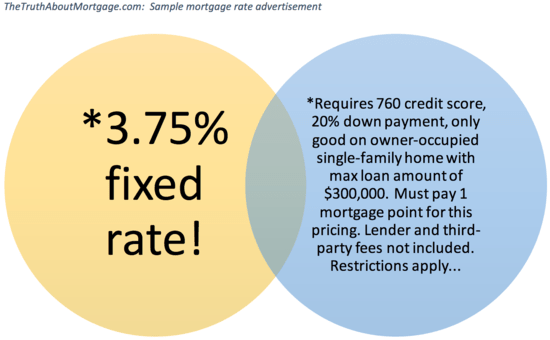
- That super low advertised mortgage rate sure looks good, but be sure to check out the fine print
- You probably have to be an A+ borrower (and you might need to pay discount points too)
- Vanilla borrowers will get access to lower rates: e.g. primary residence, single-family home, high FICO score, low LTV ratio
- Your mortgage rate might be higher if you have a low down payment, a mediocre credit score, or are buying a second home or a condo
Also note that the par rate you see advertised on TV and the web often don’t take into account any mortgage pricing adjustments or fees that could drive your actual interest up considerably.
Generally, a lender will showcase a mortgage rate that requires near-perfect credit, a 20% down payment, and is only available on an owner-occupied single-family home, as seen in my fictitious mortgage rate ad illustration above.
If your down payment or credit score isn’t that high, or your home equity is low, your mortgage rate may creep higher as well.
Occupancy and property type will also drive rates higher, assuming it’s a second home, investment property, and/or a multi-unit property. So expect to pay more if that’s the case.
If you do put less than 20% down, you’ll also have to factor in mortgage insurance, which if not explicitly charged, is usually built into the rate.
There are also loan amount restrictions…pricing can change depending on if the home loan is conforming or jumbo. Typically, monthly payments are higher on the latter, all else being equal.
The same goes for cash out refinance rates, which tend to be higher than both purchase loans and rate and term refinances.
In other words, YOU and your property matter as well. A lot!
Advertised Mortgage Rates Assume the Borrower is Low-Risk
If you’re a risky borrower, at least in the eyes of prospective mortgage lenders, your mortgage rate may not be as low as what you see advertised.
Things like a poor credit score and a small down payment could lead to a much higher mortgage rate, whereas borrowers with stellar credit and plenty of assets may get access to the lowest fixed rates available.
At the borrower level, the biggest factor in determining the price of a mortgage is typically credit score.
One of the most important factors that you can control is your credit score, so if you can at least get a handle on that and work to keep your scores above 780, your pricing should be optimal, all else being equal.
Pay Attention to the Points Required to Get a Certain Mortgage Rate
Additionally, your mortgage rate can shift quite a bit depending on if you pay mortgage points or not, and how many points you wind up paying.
There are loan calculators that will tell if paying points make sense depending on your situation, how long you plan to stay in the home, and so on.
Rates can also vary substantially based on how much a certain lender charges to originate your loan. So the final rate can be manipulated by both you and your lender, regardless of what the going rate happens to be.
For example, the well-known mortgage companies that advertise on TV might be more expensive than the no-name brand, but at the end of the day the product might be exactly the same.
Lastly, note that there are a variety of different loan programs available with different interest rates.
Are we talking about a 30-year fixed rate or an adjustable-rate mortgage, the latter of which will have a lower interest rate. Loan type and loan amounts can play a big role here.
Freddie Mac’s Weekly Mortgage Rate Survey (updated 9/10/26)
Below are Freddie Mac’s average mortgage rates, updated weekly every Thursday morning.
This should give you a decent idea of current mortgage rates, though as mentioned, they’re just averages and your rate may vary considerably depending on the many factors mentioned above.
The data is collected the prior Thursday through Wednesday, so they aren’t necessarily going to match up with today’s mortgage rates if rates increased or fell from then until now.
Yes, mortgage rates can change daily, so consider this a mere starting point:
| Loan Program | Rate This Week | Rate Last Week | Rate a Year Ago |
| 30-Year Fixed | 6.76% | 6.71% | 6.35% |
| 15-Year Fixed | 6.09% | 6.04% | 5.50% |
| **5/1 ARM | 6.06% | 5.95% | 2.53% |
———-Mortgage rates are currently trending UP———-
* signifies a record low. ** 5/1 ARM no longer tracked as of November 10th, 2022
Since 1971, Freddie Mac has conducted a weekly survey of consumer mortgage rates.
These are average home loan rates gathered from banks, lenders, and credit unions throughout the nation.
They apply to conventional, conforming home purchase mortgages with an LTV ratio of 80 percent (20% home equity or down payment).
Note that these averages don’t apply to government home loans like VA loans or an FHA mortgage.
The numbers are based on quotes offered to “prime” borrowers, those with excellent credit scores, meaning best-case pricing for the most part.
I believe the property type in the survey is for a one-unit primary residence as well. So expect a rate increase if it’s a vacation home or rental property, or multi-unit property.
In other words, your mortgage rate may deviate from the national average for any number of reasons. But if your home loan is pretty run of the mill, you might expect pricing to be similar.
As you can see, 30-year fixed mortgage rates are the most expensive relative to the 15-year fixed and select adjustable-rate mortgages.
30-Year Fixed Mortgage Rates Are the Highest
This is the case because the 30-year fixed rate never changes, and it’s offered for a full three decades. So you pay a premium for the stability and lack of risk, and the opportunity to refinance if rates happen to go down.
Rates on the 15-year fixed are significantly cheaper, but you get half the time to pay it off. This means larger monthly payments and a lot less interest paid.
When it comes to 20-year mortgage rates, you might be looking at something in between the 30-year and 15-year, such as a quarter percent (0.25%) below the 30-year fixed. The shorter term means you’ll also save a ton on interest.
Rates on ARMs are discounted at the outset because you only get a limited fixed period before they become adjustable, at which point they generally rise.
Grab a mortgage calculator and price out different loan types to see what makes the most sense for your situation.
You can use these average rates as a starting point when determining what rate you might be offered. If your particular loan scenario is higher risk, whether it’s a higher LTV and/or a lower credit score, it will probably be priced higher.
If you’re looking for current mortgage interest rates, you can take a gander at these weekly averages to see both the direction of rates and the ballpark figures to at least get an estimate of what you might receive at any given time.
Tip: What mortgage rate can I get with my credit score?
Record Low Mortgage Rates in 2021
- Mortgage rates hit record lows during the week ending January 7th, 2021
- The 30-year fixed fell to a new all-time low of 2.65% per Freddie Mac
- Previously it had been as low as 2.67% during the week ended December 31st, 2020
- The 15-year fixed hit its all-time low of 2.10% the week ending July 29th, 2021
During the week ending January 7th, 2021, 30-year fixed mortgage rates hit new all-time lows.
The popular 30-year fixed fell to 2.65% from 2.67%, per Freddie Mac, the lowest point since tracking began all the way back in 1971.
Somewhat amazingly, there were 16 new record lows set for mortgage rates in 2020, and one new record in 2021.
The 15-year fixed hit a record low of 2.10% during the week ending July 29th, 2021, the lowest point since tracking began in 1991.
It had been as low as 2.56% during the week ended May 2nd, 2013 before reaching these more recent new all-time lows several times in 2020 and 2021.
During the same week back in 2013, the 5/1 ARM also hit its all-time record low of 2.56%, though records only date back to 2005.
It has since reached a new record low 2.40% during the week ending August 5th, 2021.
Finally, the one-year ARM fell to 2.41% during the week ended April 10, 2014, its lowest point on record since 1984.
Most economists don’t see rates falling back to these lows again, though anything is possible if the economy warrants such a move. Spoiler alert, rates hit new lows!
Mortgage Rate Forecast for 2026 and 2027
Wondering if mortgage rates are going up or down in 2026 and the year after? Wonder no longer.
The following table provides 2026 mortgage rate predictions for the 30-year fixed from well-known groups in the industry, along with a 2027 estimate if available.
Take them with a grain of salt because they’re not necessarily accurate, just forecasts for future rate movement.
| Mortgage Rate Predictions | Q1 2026 | Q2 2026 | Q3 2026 | Q4 2026 | 2027 |
| Fannie Mae | 6.2% | 6.1% | 6.0% | 5.9% | 5.9% |
| Freddie Mac | N/A | N/A | N/A | N/A | N/A |
| MBA | 6.4% | 6.4% | 6.4% | 6.4% | 6.4% |
| NAR | 6.0% | 6.0% | 6.0% | 6.0% | N/A |
As you can see, mortgage rates are projected to pretty darn flat in 2026. So if you’re in the market to buy real estate or refinance an existing home loan, conditions should at least become more stable in terms of financing.
Of course, it will vary slightly depending on which forecast you believe. Some expect mortgage rates to fall into the high 5% range in 2026, which should be welcome news to most.
Mortgage Rate FAQ
1. How are mortgage rates set?
Mortgage rates are determined by both external factors, such as economic growth, inflation, and demand for bonds, specifically mortgage-backed securities (MBS), along with borrower- and property-specific attributes.
2. What role does the 10-year Treasury play?
Mortgage rates correlate well with the 10-year Treasury yield, which is used as a benchmark for mortgage maturity because most home loans are paid off within a decade too. Mortgage lenders add a spread above the 10-year (historically around 170 basis points) to account for risks unique to MBS such as credit and prepayment risk.
3. Why do mortgage rates change?
They can fluctuate due to economic factors like inflation, fluctuations in 10-year Treasury yields, Fed policies such as QE or QT, and appetite for MBS (supply/demand). Rates can change daily or even intraday based on market conditions, similar to stocks.
4. How does the economy affect mortgage rates?
Simply put, a strong economy (high inflation, job growth) tends to lead to higher mortgage rates, while a weak economy (low inflation, high unemployment) lowers them. Investors usually make a flight to safety to bonds during economic downturns, increasing bond prices and reducing their yields (interest rates).
5. What role does the Federal Reserve play in mortgage rates?
Historically, the Fed only set short-term rates via its federal funds rate, which arguably influences long-term rates on mortgages, but in recent years became directly involved via QE (lowering mortgage rates by buying trillions of MBS).
6. What are mortgage-backed securities (MBS), and how do they affect rates?
MBS are bonds created with pools of residential mortgages that are bundled and sold to investors. High demand (such as the Fed’s QE) raises MBS prices and lowers mortgage rates. Reduced demand lowers MBS prices, raising rates as a result.
7. How do jobs reports and inflation data (like CPI, PPI, PCE) impact rates?
A strong jobs report or hot CPI data signals economic growth, which will typically push rates higher. Weak jobs and/or low inflation can have the opposite effect and lower rates. Rates can be quite volatile on days when these reports are released. So be careful if locking/floating.
8. How do my borrower and property factors influence my rate?
Your credit score, down payment, LTV ratio, property type (e.g. primary vs. second home or NOO), and loan type can all affect your rate. A high credit score (780+), 20% down payment, and owner-occupied property get access to lower rates; riskier profiles such as low credit scores and non-owner occupied properties will raise rates.
9. What are mortgage points, and how do they affect my rate?
Discount points are a form of prepaid interest (e.g. 1% of the loan amount) that lower your rate for the life of the loan. They can save you money long-term if you stay in the home, but calculate if it’s worth it based on your expected loan tenure.
10. Why do survey rates and advertised rates differ from what I’m offered?
Mortgage survey rates and advertised rates (e.g. Freddie Mac’s 6.65% for a 30-year fixed on 3/13/25) typically assume you’re a prime borrower (excellent credit, 20% down, primary residence). Your rate may be higher (or lower) based on your risk profile and/or lender fees.
Rates and fees can also differ tremendously between lenders for the same exact loan scenario, which is why it’s imperative to shop around and gather multiple quotes.
11. Why were mortgage rates so low in 2020–2021, and why have they risen since?
The record low rates (2.65% 30-year fixed in 2021) resulted from the Fed’s QE program and associated global pandemic slowdown. Rising rates (~6.75% in 2025) stem from higher economic growth, hotter inflation, and Quantitative Tightening (QT), which is the opposite of QE. There is no longer a big buyer of MBS, as the Fed stopped buying.
12. How can I secure a lower mortgage rate?
Perhaps the best way is to boost your credit score (aim for 780+), make a 20%+ down payment, pay points if staying in the home/loan long-term, shop around and negotiate, and lock when rates are favorable.
13. How can I predict whether mortgage rates will rise or fall?
Keep a close eye on the 10-year Treasury yield, economic reports (jobs, CPI), and Fed monetary policy. That said, even the experts have a hard time predicting the future with any degree of certainty. You can also consult with your loan officer or mortgage broker to determine when to lock your rate.
14. Are mortgage rates going up or down in 2026?
Forecasts predict rates will trend flat to slightly lower in 2026, falling from around 6.25% to the high 5% range for the 30-year fixed by late 2026 (e.g. Fannie Mae 5.9%, NAR 6.0%). But these are simply estimates and can shift at any time.
Read more: What mortgage rate can I expect?

- Mortgage Rates Are Now 1% Higher Than They Were a Year Ago - September 14, 2026
- Welcome Back 7% Mortgage Rates - September 10, 2026
- President Trump, Who Campaigned on Bringing Back 2% Mortgage Rates, Faces 7% Rates as Midterms Approach - September 9, 2026
why do real estate classes tell you to buy when interest rates are high than
Not sure what classes you’re referring to, but if rates are high, that’s probably a sign the economy is doing well, which could lead to home price gains.
Can anyone tell me how a bank determines one’s mortgage rate when the advertised rates are a range, e.g. 3.75%-4.125%?
“why do real estate classes tell you to buy when interest rates are high than”
Its called the monthly payment. When Interest rates are low, people can afford a larger monthly payment; this artificially pushes home prices up. When Interest rates are high, people can afford a smaller monthly payment; home prices will have to come down because of this.
Kat,
As the article states, there are a ton of mortgage pricing adjustments that can greatly alter your rate, such as your credit score, your LTV, your loan amount, your property type, the transaction type (purchase vs cash out refi), loan type, lock period, etc., etc.
Great Article! Very informative and I’ve learned a bunch. Just one question that I need to explain to the Hubs….
How exactly is a credit score calculated for a Mortgage?
(i.e., income/debt ratio, specific sales area?)
Hub’s upset mine came back higher, even though Credit Karma is showing him as about 10 points above mine?
Thank you in advance for your assistance!
Sue,
The scores you see on CK may differ from those a mortgage lender will pull, but won’t be based on income or area. I wouldn’t get upset, as long as you both have good scores it shouldn’t matter who is higher (other than pride).
With higher LTV (>80%) comes higher interest rates, but have you heard anything that LTV 80% has higher interest rate than LTV 85% due to no PMI. Sounds weird…
So Kim,
Haven’t heard of that…could be two different loan products such as FHA and conventional programs with different rates.
How come some rates are higher than others on the same day? And how come some loan officers charge so much more on your loan than the going rate…is it allowed? Can my loan officer hike up my interest rates and blame it on my credit I have a 685 credit score.
Kecia,
It’s a free market like anything else – lenders are able to charge whatever they feel is reasonable (to an extent) so rates at one bank may be higher than another if they feel they can still sell it to the customer using their brand or customer service as a selling point. A 685 score isn’t terrible, but it is low enough to cause the interest rate to rise so it’s best to get your score above 740 to avoid any price increases.
Hey bud, long time no talk to. I’m an LO now (officially tomorrow after taking the NMLS exam), and am using your website as a resource! I also referred your blog to our in-house trainer.
Hi Michael,
Thanks for the note and the referral. Good luck and here’s to hoping your loan pipeline is always full!
Colin,
This was a great article thank you! Do you have any other posts that go more in depth to how lenders determine their spreads over the baseline rates, how they price them out and sell to secondary, and how lenders determine their minimum spreads to make their target profits? (Doing a senior finance major project on how rate pricing with mortgages works.) Any help would be greatly appreciated thank you!
Andy,
That’s pretty much it because this is a consumer-oriented post. Good luck in your research.
Man the closing cost put in the loan is the way to go
Walter,
It can be, especially if you don’t keep the mortgage long.
Higher interest rate could be one way to say it, but I’d just say higher cost of doing the loan. it is true that a loan may be priced worse at 80 LTV than 85 due to PMI. Lender faces higher risk at 80 LTV with no MI vs. 85 LTV and MI.
Dc,
Interesting point, and often MI is baked into the loan, which in turn equates to a higher rate.
Good article! I’m interested in how it was determined that adding 1.7% accounts for the difference in risk between 10-yr Treasuries and mortgage loans. Is there a reference you can direct me to? Thanx :)
Jim,
Just a historical spread for a Treasury vs. 30-year fixed rate as the former is guaranteed and the latter is subject to prepayment, default, etc.